Exercises
Eight problems to read

These eight problems go with Reading the Wall, a technique handbook for indoor bouldering. They are invented. No gym has set them and nobody has climbed them, so the grades are rough and the beta is the book’s judgement. They run from about V2 to about V6 in different styles. The harder ones are worth reading even if you can’t climb that grade yet.
Read each drawing with the method in the book’s Section 2.2. Answer the prompts and make your plan, then open the answer and compare. Your beta may be as good as this one, especially if you are much taller or smaller than the climber in the drawings. That climber stands about 1.75 m and reaches about 2.1 m from toes to fingers (about ten and a half bolt holes).
Reading the drawings
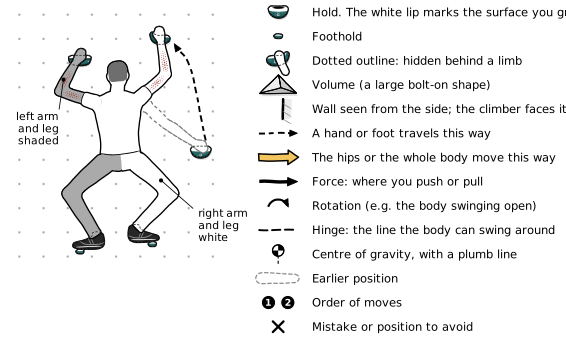
Letters mark holds big enough for a hand. Numbers mark holds only a foot can use, though a lettered hold can still take a foot. Letters and numbers run up the wall (or along it on the traverse), so their order says nothing about the sequence. Tape marks the start, and volumes count. The dots are bolt holes 20 cm apart, so you can count distances as “Reading for your size” suggests. Short streaks on a hold are shoe rubber. A smudge just below its lip is chalk.
On the answer drawings, D R3 means hold D, taken by the right hand as the third hand move. The numbered moves also count the feet, so the two numbers don’t match.
Key to the drawings
Most drawings show the climber from behind, facing the wall, as you would see a friend from the mats.
The problems
- 1 Slab V2
The wall leans back 15°, seen from behind.
- 2 Traverse V3
The wall overhangs 10° and runs to the right, seen from behind. D’s back is smooth, so you can’t pinch it.
- 3 Overhang V3
The wall overhangs 20°, seen from behind. B has room for two hands.
- 4 Steep wall V4
The wall overhangs 35°, seen from the side. The lettered holds run in one line, about 50 cm apart along it. A has room for two hands and C for one. Foothold 3 is wide enough for two feet.
- 5 Sit start V4
The wall overhangs 15°, seen from behind.
- 6 Long gap V5
The wall overhangs 25°, seen from behind.
- 7 Volumes V5
The wall overhangs 25°, seen from behind. Y stands about 45 cm off the wall. Neither volume has an edge to grip.
- 8 Cave V6
The wall overhangs 40°, seen from behind. C has room for one hand.
To work on paper, download the booklet as a PDF. Each answer is on the back of its problem.