Chapter Seven
Terrain

In this chapter
The angle and shape of the wall decide which techniques a problem needs. On a slab you stand and balance. On an overhang you hang and pull with your feet. On an arête you fight a swing. For each kind of terrain, this chapter says what changes in your body position and what to look for before you start.
The entries here don’t repeat how to do a heel hook or a drop knee. They say where the terrain asks for one and why, and link to the full entry.
| Grade | Technique |
|---|---|
| V2 | Slab technique |
| V2 | Volumes |
| V2 | Traverses |
| V2 | Top-outs |
| V3 | Overhangs |
| Grade | Technique |
|---|---|
| V3 | Arêtes |
| V3 | Sit starts |
| V4 | Roofs |
| V5 | Dynamic slab |
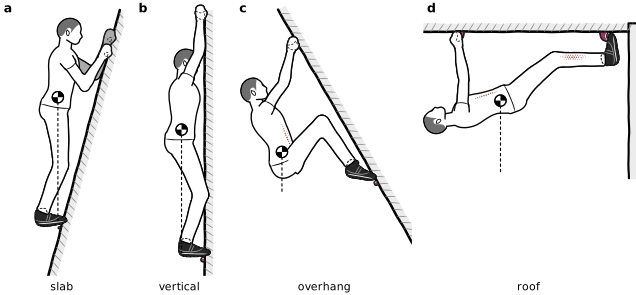
7.1 How the wall angle changes your body
The steeper the wall, the more of your weight your arms carry (Chapter 1 explains why). A volume (a big hollow shape bolted to the wall) can turn a vertical wall into a slab for one move. A study of World Cup problems counted a wall as “slab-like” when climbers mostly pushed on holds rather than pulled [65]. Use the same test: if a problem mostly asks you to push, climb it like a slab.
| Wall | Your weight and hips | Your hands | What goes wrong |
|---|---|---|---|
| Slab | Almost all your weight is on your feet. Your hips are over your toes, slightly away from the wall. | Press, palm and steer. | Feet skate off. Pulling on the hands levers the feet off [45, 46, 243]. |
| Vertical | Most of your weight stays on your feet if your hips stay close to the wall. | Stand tall. A slightly bent arm is fine. | Your hips drift out, so you over-grip [244]. |
| Overhang | Your arms carry more as the angle grows. Turn your hips sideways into the wall. | Keep your arms straight. Let your feet pull as well as push. | You stay square and bend your arms. Your feet come off [35, 47, 107]. |
| Roof | Your body is nearly horizontal. Your feet must hook to stay on. | Keep your arms straight. Foot hooks act as a third arm. | Your feet swing off [48, 113]. |
| Arête | Your weight is split between the edge and the face beside it. | Pull the edge and push with your feet. | Your body swings open like a door [50]. |
| Corner | You press out into both walls. See Stemming. | Press or rest. | You put both feet on one wall, so your arms do the work [51, 133]. |
7.2 Vertical walls
A vertical wall needs no technique of its own, but it breaks one slab habit. On a slab you can balance over one foot without your hands. On a vertical wall gravity pulls your hips out from the wall, so you can’t [244].
- Before each move, bring your hips in towards the wall as well as over the heel of the standing foot. Climbers who move their hips only left and right leave them slightly out, so they put weight on their arms and over-grip [244].
- Stand on the inside edge of the shoe with your hips more or less square. Switch to the outside edge (the little-toe side) with crossed legs when the holds line up. When they don’t, flag instead of swapping feet [39]. See Edging.
- On a volume, stand on the far side, away from the wall. See Volumes.