Also called comp slab, coordination slab · Terrain
Modern gym slab often isn’t slow balance: you jump or run between volumes and catch holds and footholds while moving. The skill is planning where your body must end up, so you arrive balanced [44, 52].
Grade One gym’s circuits (colour groups of problems) move from teaching skills to testing them with dynamic moves around V4–V6[55]. In the 2019 World Cup finals, 18% of problems had a coordination move (at least three hand or foot placements within two seconds) [65].
How to do it
Warm up hips, knees and ankles as well as fingers. You will fall a lot, from odd positions, so learn to fall first (Chapter 9) [44].
Read the end position first. Where must each foot and hand be when the move stops? Plan the steps backwards from there [44, 52].
Decide how far from the wall you take off and land. Aim for an arc that ends balanced, not chest against the wall or overstretched [44, 52].
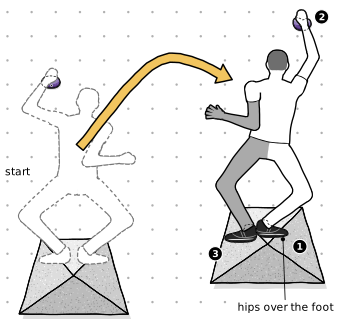
On a volume, land on the far side, hips over your feet. See Volumes[44].
Stay relaxed until the catch. Tense only as you land [44, 52].
Think “pull my body into the end position”, not “grab the hold” [52].
Work long sequences one contact at a time. Get the first right, then add the second [44].
Where the fall is safe, try to ride out a foot slip instead of jumping off [44].
Figure 94 Plan from the end. The climber starts on the left volume (dashed). The plan: land the right foot on the far volume (1). Catch the sloper (2). Then place the left foot (3).