Also called smear, smedging, Reibungstritt · Feet and legs
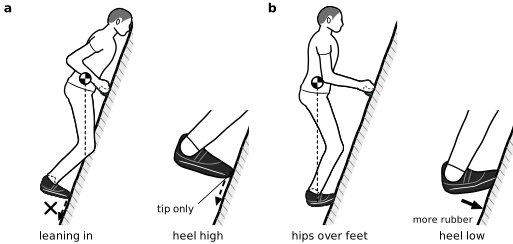
You press the sole against blank wall, the face of a volume or a rounded foothold, so friction holds you instead of an edge. Dropping the heel puts more rubber on the wall.
Grade Gym slabs and volumes ask for it from V1. From V3 it often decides slab and volume problems (judgement).
How to do it
Choose the spot precisely. Weigh the spot that gives the best body position against the most featured patch of wall [86].
Put the toe on first, as if placing a stamp. The foot points almost straight at the wall [97].
Drop the heel. More rubber then touches the wall [81, 86, 95]. In a small dip, keep the heel higher. That loads the front of the foot [98].
Keep your weight over the big toe [98]. Press into the wall, at right angles to its surface [97].
Bend the knees towards the wall. Stand tall over your feet. Don’t lean in and don’t lean back [86, 97].
Shift weight smoothly from foot to foot. Several small steps beat one big one [86].
Figure 14 Side view of a slab, with a close-up of the foot beside each climber. (a) Leaning in, heel high: only the tip touches, and the foot skates down the wall. (b) Hips over the feet, heel low: more rubber presses into the wall.
On a volume: drop the heel well down. Soft shoes help [82, 95].
Smedging (smearing on a tiny edge): use the front of the toe. Press the rubber onto the edge so it moulds round it [86].
Swapping feet on a smear: press the heel down into the wall, or you slip [99].
Common mistakes
Fidgeting with test placements. Place the foot once and load it [86].