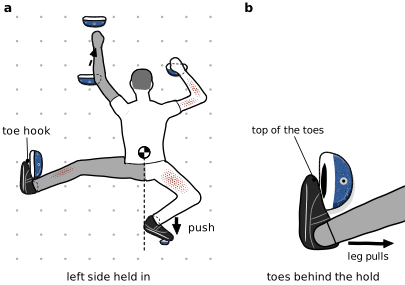
You hook the top of your foot under or behind a hold so the leg can keep your body in place. That mostly gives stability, not pull [114].
Grade One forum poster lists it with heel hooks from V3[76]. It starts deciding problems around V4 (judgement).
How to do it
Use the top of the foot, not the tip. Fit the shoe into the hold like a puzzle piece. On deep holds, hook higher up, on the laces [114].
Set the hook with the ankle bent up towards the shin [90, 102].
Hold it with leg tension, not by curling the toes. The coach Kris Hampton says curling and pulling is why toe hooks feel so hard to keep on [114].
Straighten the hooking leg if you can. Lower your hips so your weight hangs on the toe [114]. Then keep the leg firm [90].
Push the other foot against a hold below your centre of gravity (your balance point, near your navel) [90, 112]. Or pull the hooked foot and the opposite hand towards each other [114].
Once the hook is stable, move a hand or the other foot [114].
Plan the release as small foot moves. If you must let go, take one foot off first [49].
Sources disagree on the ankle. The chalk maker Friction Labs and Gresham say to flex it and pull with the shin [49, 90]. Hampton says hard flexing makes the hook harder to hold [114]. Flex enough to set the hook, then hold it with your leg and the opposite pull.
Figure 23 (a) The left toes hook behind a hold out to the side. They keep the left side in while the left hand moves. The right foot pushes. (b) Close-up from behind: the ankle is flexed and the top of the toes presses on the far side of the hold. The leg pulls towards the body.
Common mistakes
Hooking half-heartedly, so the foot creeps out [49].
Missing hooks you can’t see, round the sides of features [49].
Tall climbers. Long legs reach toe hooks far out to the side with a straight leg, the set-up Hampton recommends [114]. The cost is a longer lever, so you need more tension to stop the swing when you let go (judgement).