Also called tension, core tension, keeping your feet on · Body positioning
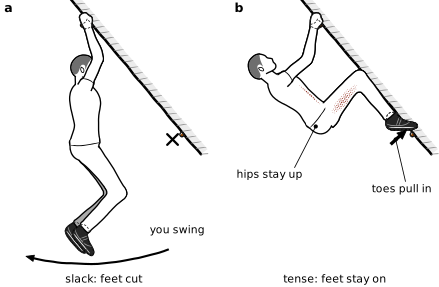
Tension runs from your toes through your legs and trunk to your fingers. It keeps your feet loaded on a steep wall while a hand moves [23].
Grade Hooper’s Beta stresses it on a steep V3[153]. On caves and roofs it matters earlier. A US gym still teaches it in its course for climbers stuck at V5[141].
How to do it
Press your toes into the footholds. Keep the pressure on while you move.
Pull with the backs of your thighs and your inner thighs. These hamstrings and inner-thigh muscles hold the feet against the wall [22].
Keep your hips at the balance point. A sagging trunk loses the squeeze [15]. Hips jammed into the wall unload the feet [14].
Set your shoulder blades when you catch a hold [10].
Before a hand moves, check that both feet are loaded. Relax the arm that will move [14].
During foot swaps on overhangs, a quick flick of the hips stops your legs swinging out [105].
Figure 40 Side view, 40° overhang. (a) Slack: the feet cut and you swing under your hands. (b) Tense: the toes pull into the wall and the hips stay up.
Common mistakes
Treating it as a core-strength problem. It is mostly technique and coordination [23].
Tall climbers. A long body is a long lever between your hands and your feet, so you need more tension to keep your feet on in a roof. Bringing your feet higher shortens the lever.