Reading the WallBody positioning

Sitting into it

V3+

Before a move, you lower your hips onto bent legs with your arms straight, so your feet press hard into the wall. You drive the move from there [151].

Grade From about V3, overhanging moves need leg power from a loaded start. Hooper calls straight-armed starts the essential tool for overhangs [151].

How to do it

  1. Set your feet with your heels low [151].
  2. Straighten your arms.
  3. Let your hips sit down and slightly out until your feet press firmly into the wall [151].
  4. Hooper’s cue: get as far from your bottom hand as you can while staying balanced [14].
  5. Relax the arm that will move next [14].
  6. Drive with your legs. Move your hips up and in. Pull only at the end [151].
  7. On slopers, sit with your hips low and close to the wall. Keep your trunk tight [15].
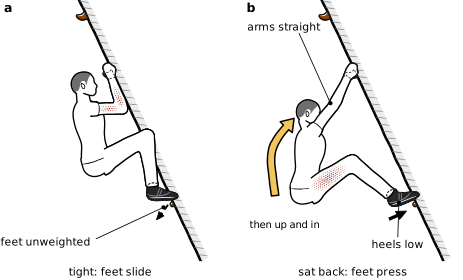
A climber on an overhang from the side, first pulled in tight, then sitting back on straight arms with the feet pressing.
Figure 39 (a) Pulled in tight: knees at the wall, feet barely weighted. (b) Sat back: arms straight, hips and heels low. The hips then drive up and in.

Common mistakes

  • Sitting low on a slab or vertical wall. It moves weight from your feet to your fingers [2].
  • Staying “sucked in”. Your feet unload [14].
  • Pausing before the hard move until your momentum is gone [152].
Tall climbers. Long legs let you sit deep, but then your hips end up far below and away from the next hold. Sit only as deep as your feet need to press.
Related
Straight arms, Deadpoint, Body tension, Hip pump
Watch
Why You Have NO POWER On Overhangs – Coaching w/ Dan #3 (Hooper’s Beta); Why Do Climbers that “Stay Tight” Have Poor Body Tension? – Coaching w/ Dan #4 (Hooper’s Beta)
Sources
[2, 14, 15, 151, 152]
Referenced from
Straight arms, Body tension, Sit starts