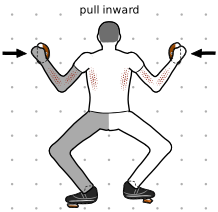
Also called counter-pressure, push–pull, opposing forces · Body positioning
Two contacts push or pull against each other, so holds that are useless alone start to work [16]. The sideways forces cancel out. The squeeze presses skin and rubber onto the holds, so friction holds you up.
Grade Hand-against-foot opposition, as in a layback, appears from V2. Squeezing with two hands appears from V3–V4.
How to do it
Read which way each hold faces. Pull the opposite way [42].
Find a partner contact that pushes or pulls the opposite way.
Hand against hand: pull two sidepulls towards your chest. Or push two gastons apart, elbows out [16].
Hand against foot: pull an undercling up while your high feet press into the wall [9]. Or pull a sidepull while the opposite foot stands on its outside edge [16].
Foot against foot: push your feet apart, as in stemming or a drop knee[132, 144]. A bicycle squeezes one hold between both feet [113].
Load both contacts at once. Then move the limb that isn’t part of the pair.
Keep your trunk tight. If your core sags, the squeeze lets go [15].
Figure 42 Two sidepulls face away from each other. Pulling them towards each other holds you on.
Common mistakes
Pulling straight down on a sidepull or undercling.
Pushing gastons apart on a steep wall for long. It strains the shoulders [16].