Volumes are big hollow shapes bolted to the wall. They act as holds, footholds and pieces of wall, but most have nothing to pull down on. You stand on their faces, press them, pinch their edges or squeeze them between your hands or feet [31, 35, 43].
Grade Standing on a volume matters from about V2. Some gyms set problems on volumes alone [31]. Those problems are harder to read and appear from about V4, which is where the squeezes and hooks in steps 7 and 8 start to pay. A knee bar comes later, around V5 (judgement).
How to do it
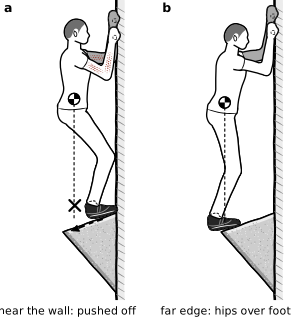
Stand on the far side of the volume, away from the wall, so your hips are over your foot. Smear with the front half of the shoe. Keep the heel lower than the toes [43, 44].
Use the whole face. Put as much rubber on it as you can. Use palms rather than fingertips. Chalk the whole hand [43].
Look for an edge. Grab it as a pinch, or as a “meat hook”: palm on one face, fingers over the other [43].
On a rounded volume, find the bulge or the scoop. Chalk marks show where others found grip [43].
On a sloping volume, get underneath it. Hang low on straight arms so gravity pulls you onto it [43]. See Sloper.
Push hands and feet against the direction you’re moving. With a flexed foot, push down and pull in with the heel [43].
On steep ground, squeeze the volume between your feet or your hands. See Compression[35, 43].
Step back and look at the sides and underside. You may find hidden holds, spots for heel and toe hooks, or room for a knee bar between close volumes [35].
Figure 86 (a) Standing near the wall on the volume’s sloping top. The slope pushes the foot out. (b) Standing on the far edge, hips over the foot, heel lower than the toe.
Common mistakes
Rushing. On holds without an obvious grip, speed works against you [43].
Standing next to the wall on vertical or slab ground. You get pushed backwards [43].
Half-committing. If you don’t expect to stay on, you won’t [43].
Tall climbers. Long arms and legs make squeezing and far-side standing easier, but they fold up between close volumes. Look for a wider span or a lower foot (judgement).
Small climbers. One head setter (the person who designs the problems) angles some volumes so that climbers can smear along the whole face, which evens out height differences [246]. So before you decide a step is too high, look along the face for a spot you can reach, on the far side if you can (judgement).