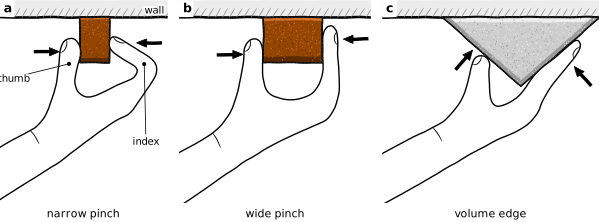
You squeeze a hold between your thumb and fingers on two opposite faces [102, 185]. Most pinches are vertical. A horizontal one is easier to use as a crimp or sloper [102].
Grade Wide pinches appear around V2–V3. Narrow pinches matter from V4–V5.
How to do it
Find two opposite faces. Put your thumb on one and your fingers on the other, so you squeeze straight across.
On a narrow pinch, squeeze between the thumb pad and the side of the index finger [168]. Bend the fingers as in a half crimp[186].
On a wide pinch, lay your fingers flat and open [186].
On a volume edge, put the thumb on one face and the fingers on the other [43].
Place your body by the pinch’s direction. Lean off it, twist, or squeeze two pinches together [186].
Grip as lightly as you can. Squeezing too hard makes you stiff [186].
Figure 59 Seen from above, with the wall at the top. The thumb and fingers squeeze across each hold.
Common mistakes
Squeezing harder instead of moving your body into line [158].
Taking a narrow pinch on a hold that offers a wide one. Compared with a jug, climbers’ pull dropped 6–19% on a wide pinch but 31–46% on a narrow one [187].
Tall climbers. Big hands help on wide pinches [180], less so on narrow ones (judgement).
Small climbers. If your thumb can’t press back on a wide pinch, you may be able to hold it like an edge [180], or pull it as a sidepull, leaning away from it (judgement).