Also called grip switching, readjusting, finding the sweet spot · Hands and holds
You change your grip on a hold after you first grab it. You might walk your fingers to the best spot, adjust as your body moves or make room for the other hand.
Grade Around V3–V4, problems start to have holds you catch one way and use another.
How to do it
From the ground, plan how you will catch the hold and how you will use it. The best place to catch it is often not the best place to pull [163].
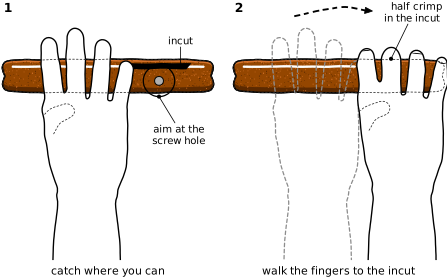
Find the sweet spot (the best part of the hold). Chalk marks, incuts, ridges and thumb dimples show it [43, 186]. On a dual texture hold, aim for the grippy patch [165].
Aim at a small mark, such as a screw hole: “aim small, miss small” [189].
Aim with your head. Put your nose where your balanced body needs to be. A fumbled hand then has time to correct [189].
Move your fingers one at a time while your weight is on your feet or the other hand.
On a long run of edges, switch between half crimp and open hand. The change rests your fingers [190].
To make room for a match, take the hold with fewer fingers, on one side, or pinch it [191]. Swap fingers across one at a time.
Figure 62 (1) Catch the hold where you can, aiming at the screw hole. (2) Walk the fingers into the incut and settle into a half crimp.
Common mistakes
Fiddling with your grip while hanging on a bent arm. Straighten it first.
Forgetting the lower hand. Climbers watch the reaching hand and lose the holding one [158].