A pocket is a hole for one or more fingers [102]. A one-finger pocket is a mono. The risk lies in the fingers you leave out, because curling them hard into the palm strains the small muscles between the fingers [192, 193].
Grade Gyms set fewer pockets than outdoor limestone has, so indoors they matter around V4–V5. Injuries to the lumbricals (small muscles in the palm) are rising among climbers [194].
How to do it
Count the fingers that fit. Feel the depth: to the first joint or the second.
Three fingers: put them together in the hole [158].
Two fingers: use middle and ring, or index and middle [158]. Choose by feel [180].
Keep the fingers outside the pocket loose and roughly parallel to the pocket fingers. Don’t curl them hard into the palm [192, 193].
Use an open hand or a crimp inside, depending on depth. Don’t crimp hard over a sharp rim [168].
Load the pocket smoothly. Watch your feet: a foot slip jolts the fingers [193].
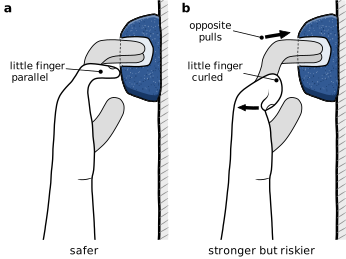
Figure 63 Two-finger pocket, middle and ring fingers in the hole. (a) Little finger kept parallel: safer. (b) Little finger curled into the palm: stronger, but it shears the muscle between it and the ring finger.
Common mistakes
Curling the little finger tight in a middle–ring pocket. The ring and little fingers then pull the muscle between them in opposite directions [192, 193]. In a lab test on donated hands, it tore at about 11 kg on average [195].
Pulling hard on pockets your fingers haven’t trained for [196].
Tall climbers. Large fingers fit fewer fingers into a pocket [180]. That pushes you into two-finger pockets and monos. Keep the outside fingers parallel there.