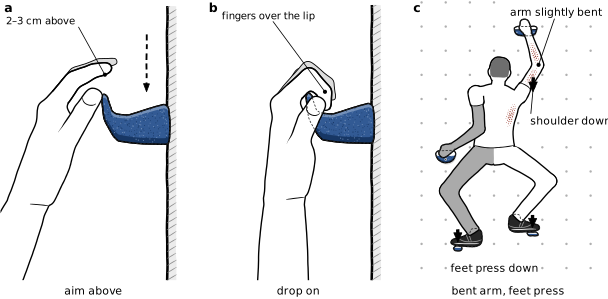
You close your hand on a hold while still moving. Then your shoulder and stomach stop your body, so you stay on.
Grade Learn it with your first deadpoints and dynos, on big holds (this book’s suggestion). Once dynos and long deadpoints appear at V4–V5, the catch is often harder than the jump. Holding the swing is sometimes “the most difficult part” [218].
How to do it
Arrive at the top of the movement, as you stop rising [208].
Lead with an open hand. Aim 2–3 cm above the hold. Drop onto its best part [216, 218].
Shape your hand before contact: open for big and rounded holds, a half crimp for edges. Don’t catch finger holds or small edges at speed in a full crimp; it risks your fingers [207].
Catch with your arm slightly bent. Pull your shoulder blade down. Don’t drop into a straight-arm hang [208, 230].
Push down through your feet as your weight arrives, so they stay on [207].
Commit. Once you touch the hold, grip it fully [207].
If the hold is poor or the swing big, bring your second hand quickly. Put it on a second hold or next to the first [207, 229].
Figure 73 (a) Arrive with an open hand just above the hold. (b) Drop your fingers over the top edge. (c) Bend the elbow, pull the shoulder down and press with the feet.
Common mistakes
Catching with a straight arm and a loose shoulder. Drill: jump to a bar, catch with bent arms and hold for two seconds [230].
Tall climbers. A tall body weighs more, so more force goes through your fingers and shoulders at the catch [208]. Where both work, choose a deadpoint over a full dyno. Practise the bar drill first.