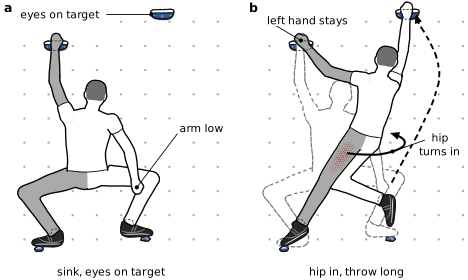
You throw dynamically to a single hold. In the basic form one foot or one hand stays on. In the full form both feet leave, but only one hand catches [207, 211]. John Gill called the all-out version a lunge [214, 231].
Grade Learn it from V3 on good holds, low on the wall (this book’s suggestion). Gyms force this dyno most often, as one big move to a single good hold. Expect it from V4 (judgement). One coach calls it a “deadpoint on overdrive” [211].
How to do it
Set up as for a deadpoint, but sink lower. Keep your eyes on the target.
Swing the throwing arm slightly back as you sink [219].
Drive with your legs. Turn the hip on the throwing side to the wall. This raises that shoulder [219].
Keep your other hand on. Push down on its hold as long as you can [207].
Throw with your arm at full stretch. Catch at the top [219].
Figure 70 (a) Sink with your eyes on the target. (b) Turn the right hip in and throw the right arm long. The left hand stays on.
Common mistakes
Lunging for small pockets. It is a common cause of finger injuries [207].
Tall climbers. You can often reach a single hold slowly with a drop knee or a side flag. If that means a hard lock-off on a steep wall, throw instead. The throw probably costs less energy (judgement) [21].