Also called cutting feet, cut loose, feet off, counter-kick · Dynamic movement
Your feet leave the wall during or after a move, either because you cut them on purpose or because they slip. You hold the swing with your shoulders and stomach, then use it to put your feet back on.
Grade On steep gym walls, many big moves at V4–V5 end with your feet off. Lattice Training notes that climbers who struggle with big moves rarely cut loose [233]. The counter-kick arrives with one-handed throws and sidepull catches at V4–V5 (judgement). The sources describe swing control but not this name.
How to do it
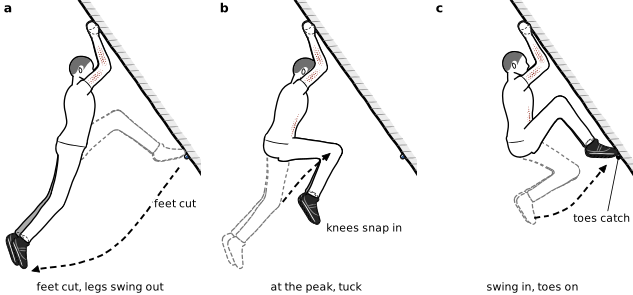
Expect the swing. Vertical walls swing little. Steep walls swing your legs out after the catch [218].
Keep your arms slightly bent while your feet are off. Pull your shoulder blades down [234].
Don’t fight the swing on the way out. Arch your back and let your legs travel [218].
At the peak, snap your stomach and legs back towards the wall [218]. Tucking your knees also shortens the swing [207].
Bend your knees on the way back in. Aim your toes at one particular foothold. Tense your lower stomach as the toes touch [93].
Missed the foot? Use the next swing. Add a little more each time until it sticks [93].
Figure 74 (a) Your feet cut and your legs swing out. (b) At the peak, tuck your knees. (c) Swing back in. Catch the foothold with your toes.
Counter-kick
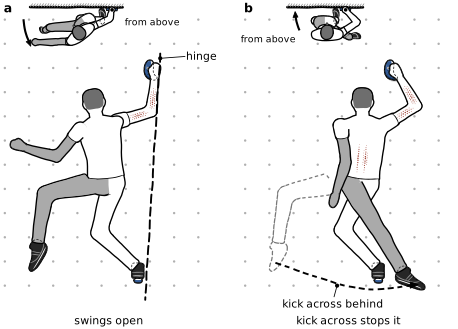
This is a different swing, with one foot still on and your body turning around your arm like a door. When that starts after a one-handed catch, kick your free leg across against it. Then let it settle into a back flag.
Before you throw, work out which way you will swing. After a right-hand catch out to the right, you usually swing open to the left.
As your hand closes, kick your free leg across behind your standing leg.
Keep that leg straight and close to the wall. A leg that drifts out pulls your hips off [224].
Relax the hip, not the knee. Let the leg settle into a back flag [224].
Tense your stomach as the swing peaks [218]. If a hold for a toe hook is in reach, catch it with your foot [219].
Figure 75 (a) After a right-hand catch, the body swings open around the right arm like a door. (b) Kicking the left leg across stops the swing and turns the body back to the wall. The insets show the body from above.
Common mistakes
Slow, straight legs (the “limp noodle”) that never reach the wall [93].
Jumping off as soon as a foot slips. Foot slips are normal, and often you can ride them out [44].
In a counter-kick, holding your free leg still instead of using it as a counterweight.
Tall climbers. Long legs swing harder. That helps you get your feet back on, but it makes the swing harder to stop, so tuck your knees early. A long leg is also a heavy counterweight, so small, quick counter-kicks are enough. Under a low roof, check that your feet won’t hit the mats.