Also called drilling the toe, toe pull · Feet and legs
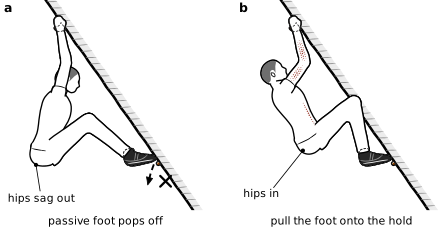
On a steep wall you drive the toe onto the foothold and pull back on it, with your whole body tight. Your feet then stay on and keep carrying weight.
Grade Needed once problems move onto steep walls with small footholds, around V3–V4. Gresham’s rule is that on steep walls you pull with your feet rather than push [35].
How to do it
Place the toe precisely on the best part of the hold. Don’t slap the wall with the ball of the foot [107].
Tighten your hamstrings (the muscles at the back of the thigh), buttocks, belly and lower back together. Drive the toe onto the hold, as if you were drilling it in [86].
Grip with the toes, as if your feet could hold on like hands [107]. Press hard through them [87].
Keep your hips close to the wall. Move the hips before you reach [107].
Turn a hip in and use the outside edge, or drop a knee. Both put more weight on your legs [35, 87].
Keep the feet loaded at the moment a hand lets go [35].
Paddling: when a big foothold sits out to the side, put the whole sole on it. Pull with the hamstring to draw your body in or to steer it [86].
Figure 20 Side view of a 35° overhang. (a) Standing passively with the hips out: the foot pops off. (b) Hips in, body tight from toe to hands, toe drilled onto the hold.
Drill: hang on two handholds on a steep training board (a standard steep wall, such as a MoonBoard). Move your feet to 10 different holds per set. Do 3–5 sets [85]. Repeat problems you normally cut loose on until your feet stay on [108].
Common mistakes
Jumping and cutting loose by habit. Gym setting often rewards it [109].
Trying to fix it with more sit-ups and trunk exercises. Practise tension on the wall instead [109].