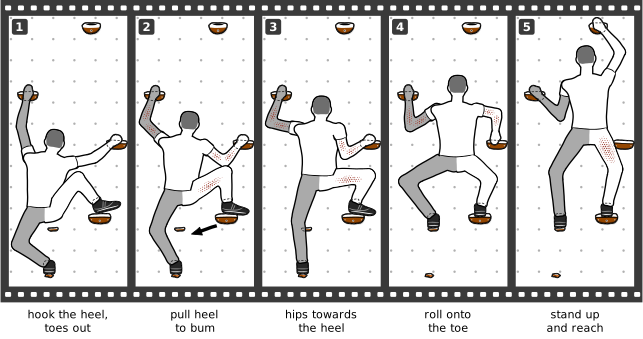
You hook the back of your heel on a hold and pull with the leg, mainly with the hamstring. The leg works like a third arm, pulling your hips in or up.
Grade Climbers on one forum report that heel hooks become necessary around V3[76, 110]. Gym clinics aimed at V5–V6 climbers still teach them [78, 79].
In motionHeel hook rock-up
Figure 21 Watch the hips: the heel pulls them up and across towards the foot. Only then does the foot roll onto the toe to stand.
How to do it
Find the spot. Look for a dip, a bump or an incut edge (one that curls inward). It will catch the heel rubber. Check for heel options before you start [91, 92].
Place the heel as precisely as you would a toe [91].
Point the toes down and away from the heel. Your knee then turns out. The calf and hamstring can pull harder [92].
Turn the ankle in towards the wall. Keep the foot 10–45° off the wall [103].
Tighten your buttocks first. Press the heel into the hold. Then pull with the hamstring [111].
Pull the heel towards your bum. Keep pulling while you move each hand [92].
To let go, first put the other foot on a solid hold. Tighten your middle. Then release slowly [92, 112].
High or low: a heel at chest height or above gains reach, while a heel below the waist gives control [112]. As you move up, turn the foot: a heel above you points the toe up, a heel at your side points it out and a low heel points it down [91].
On an arête: wrap the heel round the back of the edge. Hold it there with the hamstring. This stops you swinging open [91].
On a volume: hook a small hold on the side or top of the volume. Or drag the heel on a flat face [91].
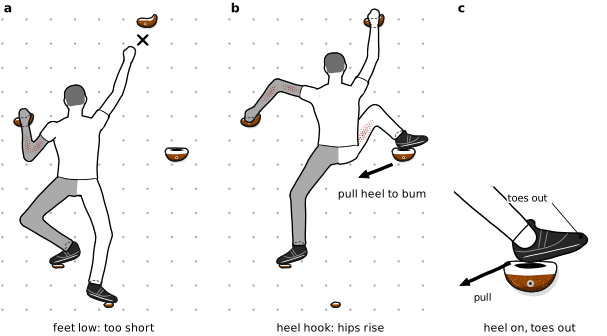
Figure 22 (a) Feet low: the right hand can’t reach. (b) The right heel hooks the hold out to the side. Pulling the heel towards the bum lifts the hips. Now the hand reaches. (c) Close-up: the heel sits on top of the hold and the toes point away.
Common mistakes
Slapping the heel on without pulling. A heel you don’t pull on won’t hold [103].
Giving up when the heel slips. Change the foot angle by a few degrees instead [91].
Wearing loose shoes, or shoes with empty space in the heel [91, 92].
Overstretching on a roof, so you have to cut loose[91].
Skipping the warm-up. Heel hooks use muscles that climbing rarely trains, so hamstring injuries are common [111].
Turning the foot out hard on a heel close to the hip without warming up. That can tear the LCL (the ligament on the outside of the knee) [103].
Tall climbers. Short climbers use heel hooks mainly to gain reach [92, 112]. You may use them more to keep your hips in and to stop swings. The hardest heels for you are the folded-up ones close to your hip, which need knee and hip mobility [103].