Also called quiet feet, silent feet, precision feet · Feet and legs
You choose one spot on the foothold, watch your foot onto it and put weight on it before you move. Done well, the foot lands without a sound and stays put. Every other entry in this chapter rests on it.
Grade Learn it from your first session (this book’s suggestion). It becomes decisive at about V2–V3, where the footholds get small (judgement). Forum climbers put the break at V3[76].
How to do it
Before you lift the foot, pick one point on the hold. Choose its best part: a corner, the deepest bit, the front edge [81, 84].
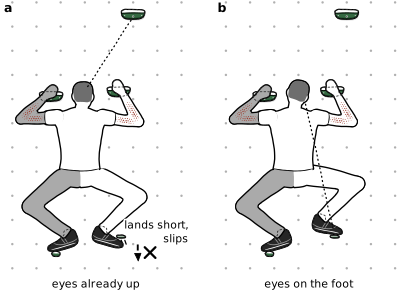
Look at that point until the foot is set [81, 94]. Then keep looking for about two seconds [85].
Use the front of the shoe, on the big-toe side [93, 95].
Bring the foot in slowly. It should touch the hold and the wall at the same moment [96].
Keep the ankle relaxed as it lands. A stiff ankle makes the noise [96]. Don’t scuff the wall above the hold [35].
Move some weight onto the foot before you stand up on it [3]. Bend the knee and lower your hips a little as you press. That sends more force through the shoe [95].
Keep the foot still while your body moves past it. Bend at the ankle instead of twisting the shoe [81, 84].
Only now move a hand.
Figure 11 (a) The eyes are already on the next handhold. The foot lands short, scuffs and slips. (b) The eyes stay on the foothold until the foot is set.
Common mistakes
Bouncing the foot round the hold. Choose the spot before you lift the foot [95].
Testing and re-testing a foot. Place it once and commit [35].
Tall climbers. Your eyes are far from your feet, which makes feet harder to place than hands [3]. Bend at the hips or turn your head to see the hold. Don’t place by memory. On a problem you work over several sessions, a small chalk mark above a key foothold is fine. Brush it off afterwards [84].