Also called foot switch, matching feet · Feet and legs
You replace one foot with the other on the same foothold. A good swap keeps your hips still and your weight on the hold.
Grade Needed on V2–V3traverses and sideways moves. Clean swaps with no swing matter from V4.
How to do it
There are three kinds of swap. Use the hop only on big holds.
Hop. Put the free foot just above the standing foot. Take a little more weight on your hands. Whip the lower foot out and let the upper one drop in [89, 94]. It is quick but inaccurate: it misses small holds, shifts your hips and jolts the hold [85, 104].
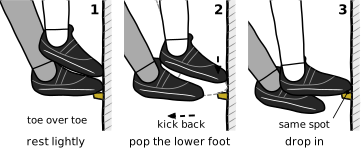
Slide (the figure):
Turn the lower foot out until its knee nearly faces the wall.
Bring the upper foot’s heel in front of the lower shin.
Rest the upper big toe lightly over the lower big toe. Don’t push down yet.
Kick the lower foot straight back, moving only the knee. Keep the hips still.
Drop the upper toe onto the exact spot the lower toe left [104].
Peel. Roll one foot off the side of the hold as the other rolls on [85, 86]. Either drop the outgoing foot to make room, or turn the incoming foot out so it lands right beside it [105].
On a big hold, put your first foot at one end. That leaves room for the second [86, 94]. On steep ground, flick your hips to stop your legs swinging out [105].
Drill: make 20 swaps, then rest. Do 3–5 sets. Start on big holds and move to small ones and smears [85].
Figure 18 The slide method, side view. (1) The right toe rests lightly over the left toe. (2) The left knee kicks the left foot back. (3) The right toe drops onto the same spot.
Common mistakes
Hopping on small holds or smears. Gresham calls it “jump and clump” [86].