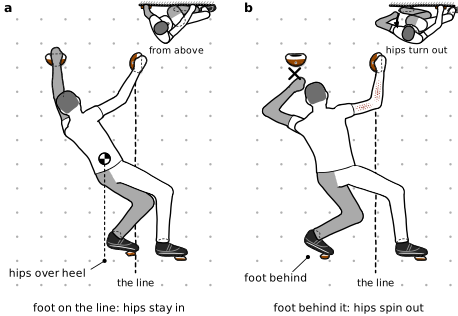
You stand on the outside edge of the reaching-side foot, on a hold below the holding hand, while the other leg flags or stands wide. Your reaching-side hip turns to the wall and your weight settles over that heel [136].
Grade Hörst starts it on boulders about 20° overhanging [137]. Rowland uses it on overhangs of about 10° or more [119]. Gym V3s on 20–30° walls start to need it.
How to do it
Hold a jug or a sidepull with the right hand. Flat edges lose grip as you turn. Gastons are the worst [121].
Find the line under the hold your right hand pulls [121].
Pick a foothold for the left foot on that line, or a little to its right. Choose one at knee height or higher [121].
Place the left foot’s outside edge on it. Point the toe down a little and lift the ankle [146]. Angle the heel away from the wall [121].
Stretch the right leg straight out to the right, or stand it on a second foothold [136, 137].
Turn your lower body until the left hip is close to the wall. Let the hips settle over the left heel [136].
Press with both feet at once. Pull the right hand down and in towards your body [137].
Stand up through the left leg and reach with the left hand [146].
Figure 35 (a) Left foot on its outside edge, on the line under the right hand. The hips settle over the heel. (b) The same foot behind the line: the hips rotate out.
Common mistakes
A foot too low to get your hips over the heel [121].
Letting the flag leg bend, so your hips drift [119].
Tall climbers. Rowland’s “knee height or higher” means your own knee. Footholds that look high to others may be perfect backsteps for you [121].
Small climbers. Turning your hip in brings you closer to the wall. Climbers’ own estimates of the extra reach run from an inch or so [59] to a few inches [61], and we found no measurement. So when the holds suit a backstep, try it before you decide a move is too far (judgement). A drop knee does a similar job if your knees are mobile enough [147], but read the knee box in Section 9.1 first.