Problem 2 Traverse
About V3. The wall overhangs 10° and runs to the right, seen from behind. D’s back is smooth, so you can’t pinch it. Start: both hands on A. Finish: both hands on E.
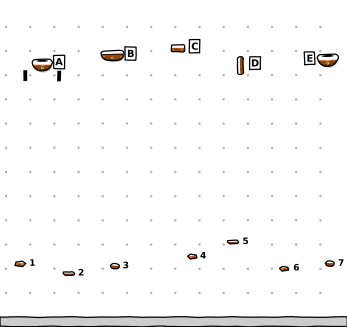
Read it yourself
- Step 3. Which way does each hold face? Where does your body go for each hand on D?
- Step 4. Give each hold an L or an R. Which holds have room for both hands?
- Step 5. Which foot do you stand on as your hand lands on D? What does the other foot do?
- Step 6. Where does the wrong hand cost you most?
The answer to problem 2
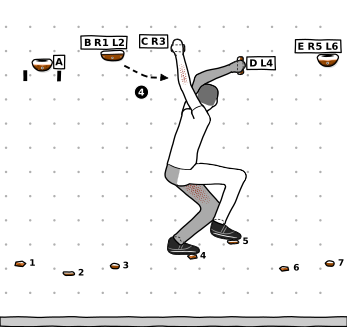
The moves
- Left foot on 1, right foot on 2. Right hand, then left hand to B. Walk your feet to right foot on 4, left foot on 3.
- Right hand to C, which faces up. Hang under it on a straight arm.
- Right foot to 5 as your off foot (it presses to stop a swing). Left foot to 4 on its outside edge, toes right (a backstep, to clear your chest).
- Turn your left hip to the wall as your left hand leaves B. Left hand under your right arm to D, which faces left. Keep your right foot pressing.
- Move your hips towards foot 5. Stand up on that foot as you let go of C. Lean right off D as your left foot pivots, toes left. Right hand to E. D is now a sidepull.
- Walk your feet along to right foot on 7, left foot on 6.
- Left hand to E.
Crux. The cross in move 4. Then letting go of C. C is a flat edge, which loses grip as you turn [121]. D holds nothing yet, so C holds you. D becomes a sidepull only once your shoulder passes it. Your right arm stops that. For a moment no hand holds you in: keep moving right.
Why the obvious try fails. The mistake is arriving at D with the wrong hand. C is too small to match and D is too thin to share (judgement). So your right hand goes on to D with your left still on B. With your body on D’s left, D is a thin gaston. You then let go of B with only that to pull on. Your shoulder does most of the work [102]. It can go, but you pay twice: this gaston, then E with your left hand on C pulled sideways (judgement). Swapping hands on C leads to the same catch, after a moment on two or three fingers of a flat edge. A hold that faces back the way you came only works as a sidepull once your shoulder is past it.
What to try next. If your chest blocks the cross, roll further onto your left hip [143]. If you can’t let go of C, cross your left hand from B to C instead. Then take your right hand past D to E. You pull C about 30° sideways at the catch. If you are small, E is out of reach from C.
- Entries
- Traverses, Crossing hands, Sidepull, Backstep, Gaston