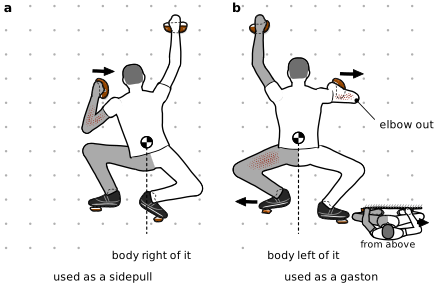
A gaston faces towards your middle, usually in front of your face or chest. You grip it thumb down and elbow out. Then you push it away from you, like prising open lift doors [133, 188].
Grade It takes a lot of shoulder power [102]. Many climbers avoid it until problems force it, which starts around V3.
How to do it
Put your fingers on the face of the hold that faces your middle. Turn your thumb down and your elbow out [133, 188].
Push the hold away from your middle. Your shoulder does most of the work [102].
Keep your elbow up, about level with your hand.
Keep the hold close to your shoulder. A gaston at full reach is weak.
Your body sits on the side the hold faces. The hold pushes your hand towards your middle, so your feet must push you back. Press the opposite foot outward, or flag[16].
Figure 61 The same left-facing hold. (a) With the body to its right, it is a left-hand sidepull. (b) With the body to its left, it is a right-hand gaston, thumb down and elbow out.
Common mistakes
Turning the thumb up and pulling it like a sidepull.
Reaching for a gaston at arm’s length. Step your feet up first.