Also called thumb catch, thumb press, thumb wrap, thumbercling, inverse crimp · Hands and holds
You use your thumb as a separate contact that hooks a dimple, presses a face or pinches an edge. That can turn a hold that is too small or too sloping into a usable one [197].
Grade Look for the thumb spot from your first crimps (this book’s suggestion). Climbers often miss the one that goes with an edge [167]. It matters most on rounded holds on steep problems [163], which mostly means V4–V5.
How to do it
Feel the hold with your thumb for bumps, dips or a second face. Give up a little of the main hold if that gets the thumb on [197].
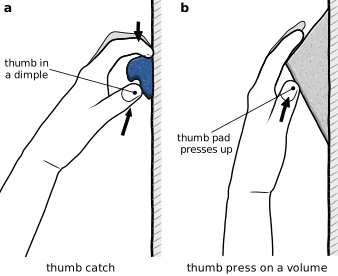
Thumb catch: press the thumb into a dimple below or beside the fingers.
Thumb press: lay the thumb pad flat on a face and push. It takes load off the fingers [197].
On asloper: try the thumb below the hold and to one side [163].
On a volume edge: put the thumb on one face and the fingers on the other [43].
Thumb wrap: on a big jug or a rail, wrap the thumb round the front [167].
Thumbercling: on an overhead hold that faces down, press up with the thumb pad. Keep the wrist and fingers straight [197].
Figure 64 (a) Fingers over a rounded edge, thumb in a dimple below. (b) Thumb pad pressing up on a volume face, fingers over the ridge.