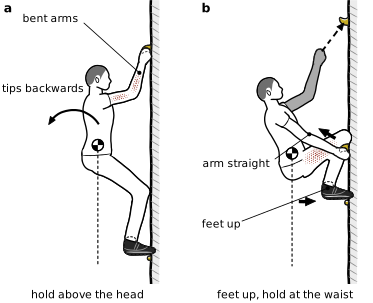
An undercling faces down. You grip it palm up and pull up and out. Your feet do the work: they push you up until the hold sits at your waist [9, 102].
Grade Underclings appear early. Using them well means getting your feet high, which most V2 climbers resist [9].
How to do it
Build your feet up first. Then reach for the hold and bring it close to your body [178].
Grip palm up with an open hand, not a crimp. Get as much hand behind it as you can. Point your thumb out [9].
Get your waist level with the hold. The higher you are, the easier it gets [9, 102].
Keep the arm straight, so your biceps can rest [9, 101].
Lean back and push your feet into the wall. Stand up into the hold [9].
To reach, stand up on one foot and turn that hip to the wall [9].
Figure 53 (a) With the hold above the head and the feet low, the arms bend and you tip backwards. (b) With the feet up, the hold sits at the waist. The arm is straight and the free hand reaches.
Common mistakes
Pulling with the arms instead of standing up with the legs [9].
Bending the wrist hard towards the little finger. Schweizer links this to fractures of a small wrist bone [161].
Tall climbers. Your waist sits high above your feet, so the hold reaches waist height with your feet lower than a shorter climber’s. Stop raising your feet once it does, because higher still folds your long legs against your chest (judgement).