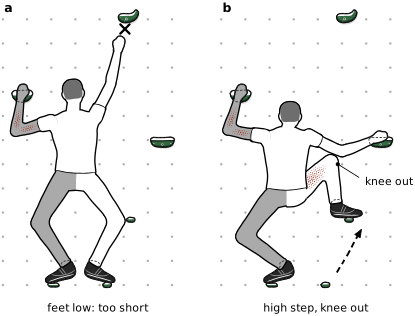
You put a foot on a hold well above the other foot, roughly mid-thigh to waist height measured from the lower foot [100]. It turns leg strength into height when the next handhold is out of reach.
Grade Common on V1–V2s with big holds far apart (judgement). From V3 the better answer is often not to high-step: Gresham calls a big high step a beginner fault where smaller steps would do [35].
How to do it
First look for a foothold in between. Two small steps usually cost less than one big one [82, 83].
Keep both hands on. Don’t haul the foot up with your arms [100].
Turn the knee out to the side. The foot can then come up beside your hip without the knee hitting the wall.
Watch the foot onto the hold. Set the toe precisely [81].
Move your hips towards the wall and over the high foot.
If you can’t shift your weight slowly, push off the lower foot. Hop your hips onto the high foot [100].
Figure 15 (a) Feet low: the right hand falls short. (b) The right foot is high on a hold beside the hip, knee up and out. A rockover comes next.
Common mistakes
Getting the foot up but leaving the hips out from the wall. You then can’t rock over.
Tall climbers. On problems set for average heights, the footholds sit close under your hands, so your knee jams against the wall or your chest. Hip mobility becomes the limit, because the knee must go out to the side. For stretches, see Section 9.1.
Small climbers. Even tiny footholds can count as the in-between step. One climber of 5 ft 6 in walks his feet up on them while his hands stay put, so his hips are already high when he commits. That means more time on the handholds. His taller partners argue that this style takes more lock-off strength, though he doubts it [62].