Also called square on, front-on, frogging, frog legs · Body positioning
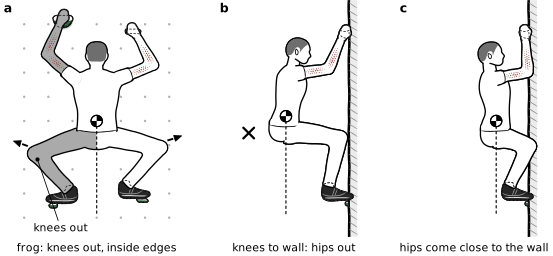
You face the wall with both hips parallel to it and stand on the inside edges of both feet. Your knees turn out to the sides, so your hips can come close to the wall between them.
Grade Square on is the default from your first climb. A deliberate frog, knees turned out, matters on V1–V2 high steps.
How to do it
Stand on two footholds at about the same height, shoulder width or wider.
Use the inside edge of each shoe: the big-toe side [128].
Turn each foot so it lies along the wall, heel turned in. This keeps your hips square and close [121].
Turn your knees out to the sides, as in a yoga squat.
On a vertical or steeper wall, bring your hips in between your knees. On a slab, keep them over your feet [3].
To step up, lift one foot to a hold near hip height, knee out. Move your hips over it and stand up [51]. See Rockover.
Figure 27 (a) Knees out, both feet on their inside edges, hips between the feet. (b) Side view. Knees pointed at the wall keep the hips out. (c) Knees out let the hips come in.
Common mistakes
Staying square on steep ground. Parallel hips push you off there. Turn a hip in instead [5].
Frogging when you need to move fast or far. Two inside edges limit how far you can move [128].
Tall climbers. Long thighs need a lot of hip turn-out to bring your pelvis close. If your hips won’t come in, widen your feet before you force your knees.