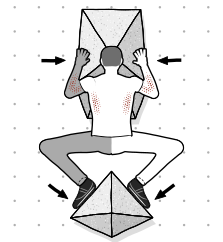
You hold yourself between two holds that face away from each other by squeezing them together with your hands and feet. The squeeze creates the friction that holds you up.
Grade Wide volume problems ask for it from V3–V4. A US gym still teaches it in its course for climbers stuck at V5[141].
How to do it
Put your hands on opposite sides of the feature, at about chest to head height.
Squeeze inward with slightly bent arms, elbows down. Use your chest and back, as in a hug.
Squeeze with your feet too. Put a toe on one side and a toe or heel on the other. A bicycle does this on one hold [113].
Press your free foot against a foothold or the wall. It can turn even a round foothold into a clamp [130].
Keep your hips close to the feature. Keep your trunk tight, so the squeeze in your hands and feet connects [15].
Release one contact only when the other three are squeezing. Move it fast.
On a pinch-shaped feature, turning side-on into a layback saves thumb strength [145].
Figure 46 The two side faces of a big volume face away from each other. The palms squeeze them inward, elbows down. The feet squeeze a lower volume.
Common mistakes
Compression heel hooks without first tensing the backs of your thighs. Gresham lists them as high-risk [156].
Tall climbers. Wide spans are more comfortable at your height, but Lattice’s client data show little link between ape index and grade [157], though one 2007 study disagrees (Section 9.1). The squeeze and the footwork matter more.