Problem 7 Volumes
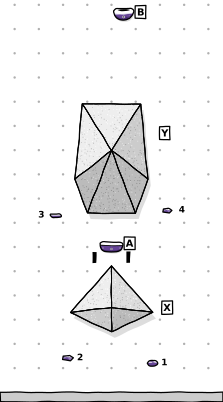
About V5. The wall overhangs 25°, seen from behind. Y stands about 45 cm off the wall. Neither volume has an edge to grip. Start: both hands on A. Finish: both hands on B.
Read it yourself
- Step 3. Which way do the faces of Y point?
- Step 4. Where can each hand go after A? Does the order matter?
- Step 5. Count the holes from your toes on X to B. What must you stand on to reach it?
- Step 6. Where is the crux? How long does it last?
The answer to problem 7
The moves
- Right foot on 1, left foot on 2. Left foot onto the left upper face of X, right foot onto the right. Squeeze X between your feet.
- Rise on X only until your left hand reaches the left face of Y: palm flat, elbow down. Your hips are still below A, so your right hand can still pull. Before they pass A, right hand to the right face, palm flat. Until it lands, nothing holds you in.
- Stand a little taller on your right foot, so your left knee has room. Left foot up to A, the old start hold. It is the nearest foothold, so your foot is off for the least time. Move it fast.
- Right foot to 4. Move your hips right round Y. Drive off both feet in one movement. Take B with your right hand as a deadpoint. It is nearly 12 holes from your toes on X and under ten from A. Your left palm only steers.
- Left hand to B.
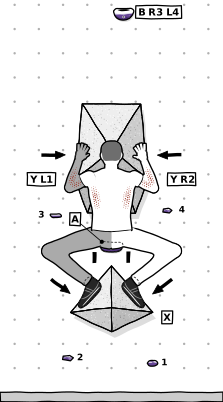
Crux. Moves 2 to 4, from the moment your right hand leaves A until it catches B. This is compression. On X your feet can only push you out, so only the squeeze holds you in. Once your right hand leaves Y, nothing does. So don’t pause.
Why the obvious try fails. You stand up on X and reach for the top of Y with one hand, the other still on A. To reach it your hips must pass A, so you can only press down on A. On an overhang a press can’t hold you in, so you fall away from the wall (judgement). Feet 3 and 4 don’t save it: with your hands on A, your hips can’t rise over them. Y’s side faces point sideways and out, so pulling down on them only slides your hands off. A knee bar under Y won’t hold either: the underside slopes out, so your knee slides off (judgement). When a volume has no edge, squeeze it instead of pulling down.
What to try next. Squeeze from your chest and back as in a hug. Keep your hips close and trunk tight [15]. If a foot pops, press your free foot on a foothold or the wall [130]. Left or right first doesn’t matter: you can climb the mirror image. A foot on A before your second hand does: it is easier on the palms. So if the squeeze won’t last, take Y with your right hand first, hips low and well left of A. Left foot to A, then left hand to Y. Chalk your whole hand [43].

- Entries
- Compression, Volumes, Palming, Body tension