Problem 5 Sit start
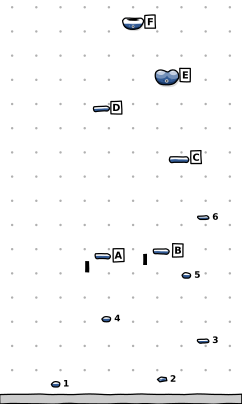
About V4. The wall overhangs 15°, seen from behind. Start: sitting on the mat with your left hand on A, your right hand on B and your feet on 1 and 2. Finish: both hands on F.
Read it yourself
- Step 1. What do you need to check with your gym before you move off a sit start?
- Step 4. Give C, D and E an L or an R.
- Step 5. What can your hips do as your bottom lifts? What does each foot do?
- Step 5, your size. Work out how many bolt holes your reach covers (toes to fingers, at 20 cm a hole). Take off one: feet 1 and 2 are too far apart to stand up straight. Then count the holes from foothold 2 to C. Can you reach it before your feet move? If not, or only just, which footholds would help? How high are they compared with your hips?
- Step 6. Where will you need the most power?
The answer to problem 5
The moves
- Left foot on 1, right foot on 2. Sit close to the wall and hang from A and B.
- Left foot to 4, about 45 cm above your hips. Rock back a little, then pull your bottom off the mat in one movement [35]. As it lifts, turn your right hip to the wall and roll onto the right foot’s outside edge.
- Right foot to 3, on its big-toe edge. Your hips come square so this foot can push. Rise between 3 and 4. Right hand to C as a small deadpoint (a catch at the top of your rise). By then A is at your waist and can only press.
- Press on A and rise until your hips clear 5. Right foot to 5: D comes well within reach.
- Left hand to D. Left foot up to A. Right hand to E. You could skip E from foot 6, but C drops below your shoulder as you stand. E stays above it.
- Right foot to 6. Stand up and catch F with your right hand. Then left hand to F.
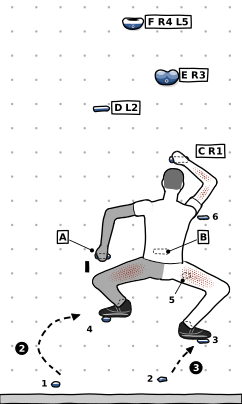
Crux. Moves 2 and 3. You pull off the mat on two flat edges. A flat edge loses grip as you turn [121]. At the catch A is at your waist, so your hand must arrive at the top of your rise.
Why the obvious try fails. You pull straight for C from feet 1 and 2. You can touch it, but only at full stretch with your left leg long. Your left hand is locked at your chest on a thin edge, with no rise left to help it (judgement). Feet 4 and 3 give you about 30 cm to spare. But set both of them before you lift and you fold up square with your bottom away from the wall. The first pull is then all arms [35].
What to try next. Roll your right knee onto the mat and push off it [35]. Don’t bounce off the mat if your gym wants a still start (judgement).


- Entries
- Sit starts, Turning the hip in, Edging, Deadpoint