Also called SDS, sit-down start, low start · Terrain
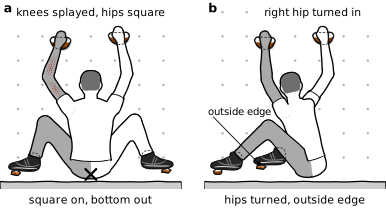
The problem starts with you sitting on the mat, hands on the start holds. The first move lifts your bottom off the floor. Turn sideways and use the outside edge of your shoe instead of folding up square [35].
Grade Sit starts become common around V3–V5 (judgement). Forum climbers say the first move off the mat often needs a burst of power [251].
Turn your hips about 90° to the wall. Stand on the outside edge of the working foot [35]. See Edging.
If both footholds are straight below the start holds, a wide frog position works too: bottom tucked close to the wall, chest dropped between your knees.
Lean back on the start holds if they allow it [35]. See Layback.
Rock back a little. Then pull and stand in one movement. Or roll one knee onto the mat and push off it [35].
Check the rule at your gym. Some gyms want you still on the start holds before you move (judgement). If in doubt, ask the staff [32].
Figure 92 (a) Square on, knees splayed, bottom away from the wall: the first pull is all arms. (b) Hips turned, outside edge on the foothold, bottom close to the wall.
Common mistakes
Bouncing off the mat on a problem whose rules want a controlled start.
Tall climbers. With long legs, your bottom may still be on the mat where a shorter climber would already hang (judgement). Sit to the side of the start holds and lay your free leg flat along the mat instead of folding your knees under your chest.