Also called roof climbing, turning the lip · Terrain
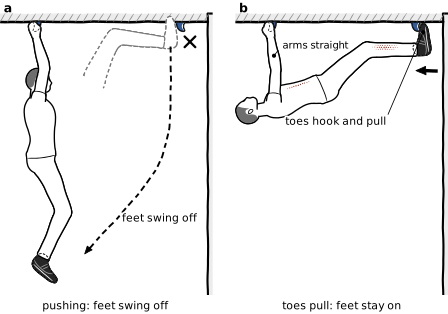
On a roof you hang underneath it and the footholds face down, so feet that push swing off. Keep them on by pulling with your toes and heels. To get over the lip where the roof ends, hook a heel over it [48, 53, 113].
Grade Roofs on low grades usually have big holds and big footholds. Once the footholds face down or sideways, around V4–V5, your feet must hook to stay on (judgement).
Keep your feet on by pulling. Flex the foot and pull the toes towards you under a hold, using your shin muscles [51, 113]. See Toe hook.
For a more solid foot, push one toe on top of a hold and hook the other toe behind it. Squeeze the feet together [48, 113]. See Bicycle.
Use heel hooks along edges and breaks as a third arm [48, 53]. See Heel hook.
Before you set a toe hook, plan how it comes out. Move your feet in small steps, so they don’t swing off when you release it [48, 49]. See Cutting loose and swing control.
Look to the sides for toe hooks. They are outside your normal view [48, 49].
On a big roof, consider going feet first. Hook a high toe, then swing your body round after it [48, 49]. If a hand slips you can tip upside down, so try it low first and ask for a spot (judgement). See Section 9.6.
At the lip, heel-hook first, then roll over the heel. See Top-outs[53, 113].
Figure 93 (a) Feet pushing on a down-facing hold swing off. (b) Arms straight and toes pulling on the hold: the feet stay on.
Common mistakes
Flat shoes. Downturned shoes clamp better. Rubber on top of the toe helps toe hooks [44, 48].
Tall climbers. Long legs reach foot hooks further from your hands, but keeping a long body flat costs more tension. Bring your feet in closer when you can.