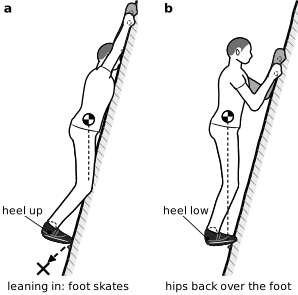
On a wall that leans back, almost all your weight can sit on your feet. Slab technique keeps it there: your hips stay over your feet, and your hands press and balance rather than pull [45, 133, 243].
Grade Slab basics matter from V2–V3, as footholds shrink to small edges and blank wall. Gyms set slab and tricky footwork on purpose, to teach footwork and to make easy problems interesting [37, 55].
How to do it
Before each step, shift your hips over the foot you will stand on. Then stand. The weight presses the shoe onto the hold [243].
Keep your hips back over your toes. Don’t press your chest to the wall. Leaning in pushes the feet outward and off [133, 243].
On a smear (a foot pressed flat on blank wall), drop the heel so more of the front of the sole touches. On small edges, stand on the big toe, not the side of the foot [45, 243].
Commit all your weight to the foot at once. Keep the pressure steady through the move. A half-weighted shoe skates [45, 245].
Take several small steps rather than one big high step [101, 245].
Use the handholds to steer, not to pull. Come at them from the side and let them guide you over your foot [46]. Where there are none, press a flat palm on the wall [243]. See Palming.
To gain height with no holds, press down on your palms. Straighten your arms as you rise [45]. See Mantle.
Rest a tired calf by putting your heel on a hold. Point the toe down and away. Shift your weight onto that heel so the calf can relax, then shake out the other leg [45].
Move slowly enough to feel each balance point [243].
Figure 85 (a) Leaning the chest in pushes the foot out and off the smear. (b) Hips stacked over the foot, heel low. The weight goes straight down through the rubber.
Common mistakes
Placing the foot near a hold rather than on its best part [45].
Testing a foothold again and again instead of committing [86, 245].
Shoes so tight they can’t bend. A looser pair helps on smears [45].