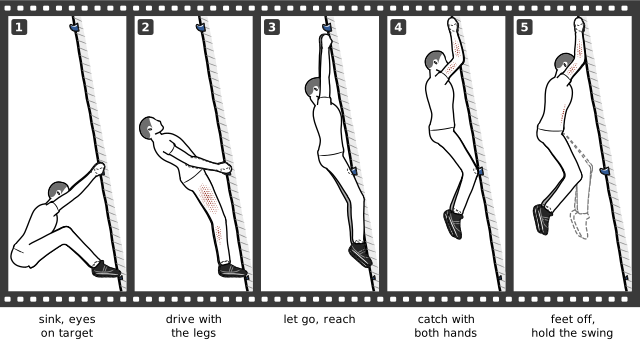
Your legs and hips launch you so that both feet leave the wall, while your arms act as a pivot. You catch the target with one or both hands [207, 209].
Grade Learn it from V2 on big holds, low on the wall, starting with a double dyno (this book’s suggestion). Gyms set dynos from about V4. A clinic for V5–V6 climbers lists them among skills “commonly found in V5–V6 boulders” [78]. Climbers at V1–V5 often lack confidence with them [205].
In motionThe dyno
Figure 71 Watch the hips sink low and out, then drive up to the wall before the hands let go.
How to do it
Put both hands on good start holds. Put your feet on the biggest footholds, 60–90 cm below. The foot on the leading-hand side goes slightly higher [229].
The farther the target, the lower you sink and the higher your feet go. Stop before you feel cramped [207, 218].
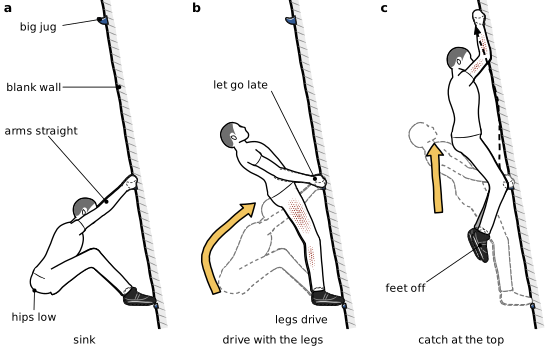
Straighten your arms. Bend your knees and drop your hips. Lock your eyes on the target [207].
Push through your feet. Keep your arms nearly straight, so your body swings up around your hands [216, 218]. One coach starts with the arms and adds the legs at chest height [229].
Arch your back to keep your hips close to the wall [220].
Hold the start holds until the movement pulls them from your hands, about when your hips pass them. Let go early and your hips fall away from the wall [220].
Reach at the top of the flight. Aim just above the hold. Catch with slightly bent arms [216, 230]. Then see Latching.
Figure 72 (a) Sink with straight arms and low hips. (b) Drive with your legs. Your body swings up around your hands. (c) Catch at the top of the flight.
Common mistakes
Facing the wall square on. Turn your hips in [218].
Learning on a slab, where knee and elbow injuries are likely. Use a gently overhanging wall [229].
Jumping without checking the landing. In one survey of boulderers hurt in falls, 22% of the falls happened on dynos [232]. Clear the mats before every go.
Reaching back with a straight arm when you miss. Cross your arms in front and land as Chapter 9 describes [232].
Tall climbers. Your long body swings through a big arc around your hands. Sink as far as the gap needs, because extra speed only gives you a bigger swing to hold [208]. On low or cramped starts, don’t jam your feet high. Take lower feet and a longer arc.