Also called lache, paddle dyno, tic-tac, double clutch · Dynamic movement
These are four moves from competition setting that you may meet in a gym: a swing and release, a row of taps, a push off a wall and a catch on two holds. The names “tic-tac” and “double clutch” are loose. We found no climbing source that uses the first, and the sources disagree on the second.
Grade These moves depend more on a gym’s setting style than on its grades (judgement). Where a gym sets them, expect them on competition-style problems from about V5. Competitions use the paddle dyno to separate the best athletes [219], but in gyms it is a set piece rather than a common need (judgement).
Lache
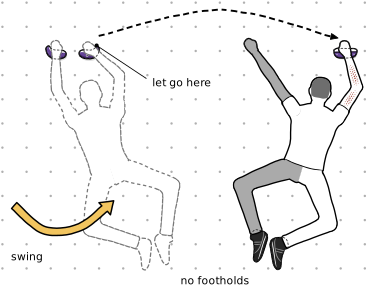
A lache is a move from parkour (running, jumping and swinging over obstacles). You swing from your hands with your feet off, then let go and fly to the next hold [210]. It is often the set-up for the hardest move, not the hardest move itself [202].
Hang with your arms slightly bent. Pull your shoulder blades down [234].
Swing your legs back and forth in the direction you want to travel, usually sideways [210].
Let go at the end of the swing towards the target, just as your body is about to stop.
Catch with the leading hand. Then bring the other hand to a second hold, or next to the first. That stops the sideways swing [207].
Figure 81 Swing, then let go at the end of the swing. Catch the far hold.
Paddle dyno
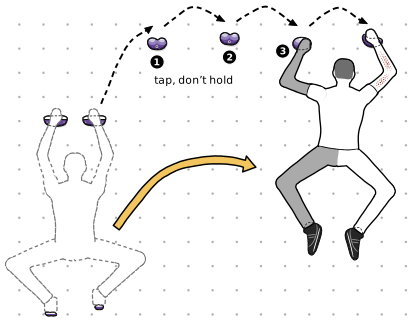
You jump, then tap your hands along a row of holds without stopping. Each touch steers your speed until you can hold the last one [210, 222].
Read the line of holds. Work out which way your body must travel between them [210, 219].
Launch as for a dyno. Aim at the first intermediate (a small hold in between) [219].
Hit each intermediate with a bent arm, so you can leave it at once [219]. Tap it. Don’t try to hold it.
Glance at each target. Then use memory and the edge of your vision for the next one [219].
Catch the last hold and absorb the swing.
Figure 82 Launch from the start holds. Tap the poor holds (1–3) with bent arms. Catch the good hold at the end.
Tic-tac
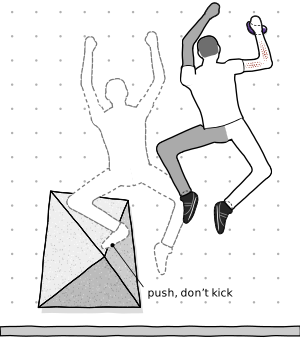
You step a foot onto a wall, an arête (an outside corner of the wall) or a volume, then push off it to send your body up or sideways to a hold. The name comes from parkour [236], though climbing writers describe “wall runs” and other parkour-style moves in competition boulders [219].
Approach at an angle to the surface you will step on [236].
Put your foot on it and push off. Don’t kick [236].
Turn your body out and up towards the target. Throw your arms at it [236].
As you catch, get a foot on at once.
Figure 83 The left foot pushes off the volume’s face. The body flies right towards the hold.
Double clutch
Your hands land on two different holds in quick succession. The first catch steers you to the second. A gym blog has both hands start on one hold and land on two new holds, one hand each [221]. A forum post describes a dyno to one hold whose speed carries you on to another [238].
Hit the first hold with the leading hand. Keep that arm slightly bent and firm [219].
Use that hand to steer your body towards the second hold.
Catch the second hold with the other hand before the swing reverses. Pull both shoulder blades down.
Common mistakes
Catching with a straight arm. On a double clutch your speed dies before the second catch.
Tall climbers. A long body is a long pendulum, so your swing is slower. On a lache, wait a moment longer before letting go than a shorter climber would.