Also called dead point, slap, dynamic layback, toter Punkt, hip pop · Dynamic movement
You throw your hips up the wall and grab the next hold at the top of that movement, when you are barely moving and feel light (this book’s reading). At least one foot stays on [21, 210, 212].
Grade Try small ones from V2 on big holds (this book’s suggestion). Gyms teach it in intermediate classes, after about two months of climbing [223]. Many V3s need it, and from V4–V5 most moves between small holds on steep walls do (judgement).
How to do it
Stand on the push foot, on the big-toe edge of the shoe. Put it below the target and a little to one side. Flag the other leg or put it on a foothold on the other side [21].
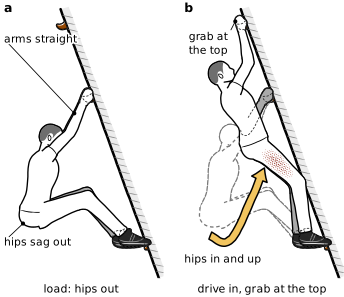
Straighten both arms. Let your hips sag out from the wall and slightly down [217].
In one movement, push off and drive up through the standing leg as if jumping. Arch your back to bring your hips to the wall. A pause anywhere kills the move [21].
Keep the holding arm straight while your hips rise. Bend it only to let your body pass.
As the rise slows, turn the reaching shoulder to the wall. Send your hand 2–3 cm above the hold, not at its edge [216].
Close your hand at the top. Then push down through your foot so it stays on [207].
Figure 66 (a) Load: keep your arms straight and let your hips sag out. (b) Drive your hips in and up. Grab at the top of the arc.
Hip pop
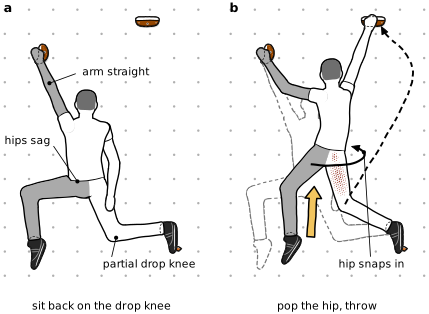
A hip pop is a deadpoint thrown from a backstep or a drop knee. The hip turned to the wall rotates in and up, which throws the hand on that side much farther than square hips can. On steep gym walls, many V4 moves are thrown this way (judgement).
Set a backstep, with the outside edge of the shoe on the hold, or a partial drop knee. The hip on that side turns to the wall [217]. Don’t snap off a deep drop knee, because the knee can take a sudden load as your hand lets go (judgement; see the knee box in Section 9.1).
Keep the holding arm straight. Let your hips sag away from the wall [217].
Push off the foot. Rotate the hip into the wall and up in one snap [217].
Turn towards the reaching arm as you go: right hip in, right shoulder up [219].
Throw the hand at the top of the rise, with the arm at full length [21, 219].
On steep walls, avoid a foot that sits “behind the line” of your body. Turn it into a drop knee instead [224].
Figure 67 (a) Set a drop knee and let your hips sag. (b) Snap the right hip into the wall and up. The right hand throws.
Common mistakes
Pulling with the arm before the hips move. Move the hips first [217].
Locking off out of habit where a deadpoint might save energy [21].
In a hip pop, a short hip swing or too little arch. Your hips stay away from the wall [224].
Snatching at a small hold. A very fast grab in a dynamic move can rupture a pulley[161].
Tall climbers. You will reach many of these holds with a slow lock-off. Deadpoint them anyway on easy problems: it may save energy [21], and on harder problems the lock-off often stops working (judgement). On short walls and in cramped sequences, a hip pop’s drop knee jams long legs, so take a higher foothold and a shorter throw (judgement).
Small climbers. Short climbers often name this as their way to far holds [60, 226, 227]. To build it, go for holds just out of reach on easy problems [106], stay low on the wall at first [147], and repeat a long move after you stick it so you learn your aim [227]. Keep big jumps for the moves that need them, and don’t snatch at small holds (judgement; see Section 9.3).