Also called flag, flagging, outside flag (US) · Body positioning
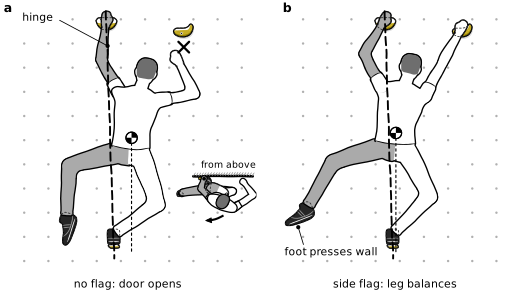
You stretch your free leg straight out to its own side and press the foot on the wall. The leg balances your weight on the far side of the hinge, so you don’t swing open [18, 20]. US sources call this an outside flag [139]. Gresham seems to use that name for a back flag[140], so this book avoids it.
Grade From about V2, reaches start to swing you open where your free foot has no hold (judgement). The UK’s coach training lists flagging as a steep-wall skill [11]. A US gym still teaches it to climbers stuck at V5[141].
How to do it
Find your hinge: the line from the hand that stays on to the foot you stand on.
Check that your free foot is already on the far side of that line from your reach. If not, use a back flag from V3 or an inside flag from V4.
Still swinging? Move the flag foot. A foot too low or too far from your body gives little leverage. On overhangs, push it up and into the wall [105].
Figure 32 The left hand sits above the right foot. (a) With the left leg dangling, reaching right swings the body open. (b) The left leg stretched out left presses the wall and balances you.