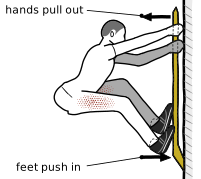
You pull sideways on a vertical edge and lean away from it while your feet push the other way against the wall. Your arms and body make the shape of a “7” [102].
Grade Arêtes and lines of sidepulls appear at V2–V3. The UK’s coach training lists laybacking as an opposition technique [11].
How to do it
Grip the edge with both hands, or one hand on it and one on the next sidepull[51, 102].
Treat the edge as a sidepull: pull it towards you and hang on the other side.
Put your feet high on the wall. Push them against the pull of your hands [51].
Keep your core (the muscles around your trunk) tight [51].
Find the point where you neither fall back nor swing round. Lose it and you swing off like a door [102].
Move your hands and feet up in short steps. Keep the push and the pull equal.
Figure 34 Side view of a flake (a thin blade standing off the wall). Straight arms pull its edge out from the wall. The feet press high on the flake. The hips hang low.
Common mistakes
Staying front-on to a sidepull or pinch with your hips parallel to the wall [145].
Feet too high. Your arms then hold more of your weight.
Tall climbers. Your long body makes a long “7”, which closes quickly when your feet go high. Keep them a little lower than a shorter climber would.