Also called cross-through, crossover, cross-under · Body positioning
You move one hand past the other to a hold beyond it. A crossover passes over the holding arm and a cross-under passes under it. The hard part is getting your chest out of the way [143].
Grade Cross-throughs on traverses start around V2. Big crosses and cross-unders on steep walls matter from V4.
How to do it
Hold with a hand you can lean on. A sidepull or undercling beats a flat edge.
Place your off foot where it stops the swing. Hooper puts it at about 90° to the line from holding hand to standing foot [130].
Keep pressing that off foot into the wall through the whole cross [130].
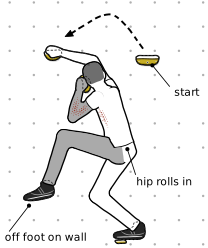
Roll: turn your chest side-on to the wall so one hip touches it. This is the default on steep ground [143].
Swim: keep your chest flat to the wall and narrow your shoulders. Use it on slabs, for wide hands, or when the feet are too poor to turn [143].
Look back at the holding hand as you move. It rolls your shoulders and adds reach [138].
For a cross-under, pass the reaching hand under the holding arm. It suits targets level with or below the holding hand.
If you add a drop knee, drop the knee on the reaching-hand side, even with your arms crossed [144].
Figure 33 Traversing left. The left hand holds a sidepull. The right hip rolls in. The left leg presses the wall. The right hand crosses over.
Common mistakes
Crossing so far that the next move becomes impossible. Check the hold after the target.
Tall climbers. Long arms cross a long way, but broad shoulders still block you. Get narrow by rolling or swimming. Don’t force the shoulder [143].