Also called hip in, hip to the wall, twisting in, side-on, getting long · Body positioning
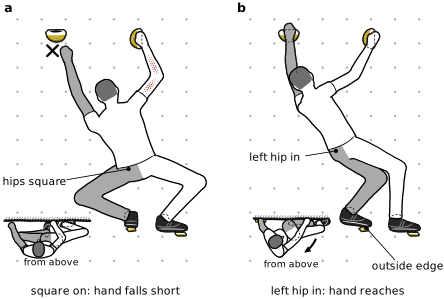
You turn your pelvis so the hip on your reaching side touches or nearly touches the wall, while your chest turns towards the holding hand. The turn lifts your reaching shoulder, so your hand goes higher on a straight arm [127, 135].
Grade Try it from V1, on easy problems that lean towards you (this book’s suggestion). You need it on your first overhangs. Gresham says low- to intermediate-level climbers struggle there because they keep their hips square [5]. Rowland twists on walls overhanging 10° or more [119].
How to do it
Hold with your right hand on a jug or a sidepull you can lean off [121]. A right-hand sidepull faces right. You hang to its left.
Put your left foot on its outside edge (the little-toe side) on a foothold below your right hand [136].
Put your right foot on a foothold out to the right, or press it on the wall [136, 137].
Turn your pelvis so your left hip goes to the wall. Your chest turns towards your right hand [16].
Keep the right arm straight and lean off it [127].
Look back at your right hand as you reach. It rolls your shoulders and adds up to a shoulder width of reach [138].
Stand up through the left leg and reach high with the left hand.
Figure 31 (a) Square on between the feet, the left hand falls short. (b) With the left foot on its outside edge and the left hip at the wall, the hand reaches. The insets show the body from above.
Common mistakes
Turning the hip without turning the foot onto its outside edge. Your knee jams.
Turning the wrong hip. The reaching side goes in [137].
Twisting on a slab with small footholds. The twist can pop your foot off [119].
Twisting on every move. Rowland reads that as a possible weakness [119].