Reading the WallBody positioning

Lock-off

V3+

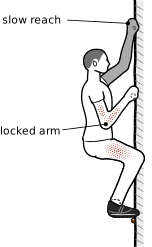
You hold one arm bent with the shoulder pulled down while the other hand lets go and reaches slowly to the next hold. You catch it without a swing.

Grade From about V3, slow reaches to small holds need it where you can’t turn in. Baker says lock-off strength matters more on steeper, harder climbs [19].

How to do it

  1. First check whether turning the hip in or a drop knee would do the job. Gresham uses them to avoid locking off [125, 144].
  2. Set your feet, as high as useful. Let your legs push you up into the lock [126].
  3. Bring the holding hand close to your shoulder. The lock is easier there [19].
  4. Keep that elbow down by your ribs, in line with the hand [13].
  5. Pull your shoulder blade down. Keep your body close to the wall [142].
  6. Reach smoothly and grip.
A climber from the side, holding a bent right arm tight to the ribs while the left arm reaches slowly up.
Figure 41 Side view. The right hand is locked beside the shoulder, with the feet high.

Common mistakes

  • Letting the elbow flare out [13].
  • Getting stuck in tight, bent-arm positions. They feel secure but cut your reach [151].
Tall climbers. You can often reach from a half lock where shorter climbers need a full one. Extra reach usually comes from rolling your shoulders, not from locking harder [138].
Small climbers. On a big reach you may need your holding hand below your shoulder, at or even below your chest, which is harder than a lock beside your shoulder. One coach under 5 ft suggests trying these deeper locks on climbs at your warm-up grade [63]. Add a few at a time, because they load your elbow and shoulder (judgement).
Related
Twist lock, Straight arms, Deadpoint, Turning the hip in
Sources
[13, 19, 63, 125, 126, 138, 142, 144, 151]
Referenced from
Straight arms: hang on your skeleton, High step, Straight arms, Turning the hip in, Backstep, Twist lock, Static or dynamic?, Deadpoint, Progression map, V3 (Font 6A/6A+), V4 (Font 6B/6B+), From V4 to V5, Learning technique, Glossary of climbing jargon