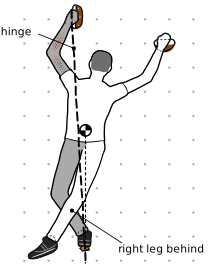
Also called rear flag, outside flag (UK), reverse flag · Body positioning
Your holding hand and standing foot are on the same side, so you cross your free leg behind the standing leg. The foot presses the wall on the far side of the hinge, so your weight balances over it [20, 139].
Grade Same-side moves on steep V3s need it. Rowland says his hip-turned version, the reverse flag, is “almost never necessary (or useful) at grades below 5.9 or V4” [119].
How to do it
Stand on your left foot, under your left hand.
Cross your right leg behind your left calf. Put the right foot on the wall, left of and below the left foot [20].
Keep that leg straight. Press the foot into the wall [20, 142].
Keep your right hip tucked against the wall [139].
Reach with your right hand.
High standing foot? Pull up with your hips square. Swing the free leg under and behind as you rise. Find balance at the top, not before [140].
Reverse flag: also turn your hips into the wall as you cross. It costs more arm strength than a backstep. Use it when every foothold is on the holding-hand side and too high or small to backstep [119, 123].
Figure 36 The left hand and left foot hold you. The right leg crosses behind the left and presses the wall. Your centre of gravity sits on the hinge.