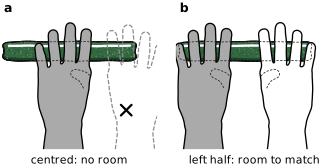
You bring your second hand onto the hold your first hand is on. That frees the first hand for the next move or gives you a rest [102].
Grade Matching a jug is a first-session skill. Leaving room on small holds matters from about V3. The UK’s coach training lists hand swapping as a movement skill [124].
How to do it
Decide before you reach a hold whether you will match it.
If you will, catch it on the half away from the incoming hand. A left hand that the right will join takes the left half.
On a small hold, catch it with two or three fingers. Or slide the first hand off as the second slides on.
Set a foot under the hold first if you can. Then the match needs no big shift of your hips.
After matching, move your weight to the hand that stays. Then let the other go.
Figure 28 (a) The left hand in the middle of the edge leaves no room. (b) The left hand on the left half leaves room for the right.
Common mistakes
Matching where a cross would save a move. See Crossing hands.
Matching with low feet and bent arms. Set your feet first.