Also called bridging, stem, corners, dihedral, open book, inside corner · Body positioning
You push your feet outward against two surfaces that face each other, such as the walls of a corner. The push presses your shoes onto them, so friction holds you without good holds [132]. Your legs carry the weight, so your arms can rest.
Grade Corners and pairs of volumes appear on easy problems, where they mostly help you rest and save effort (judgement). The UK’s coach training lists bridging as an opposition technique [11].
How to do it
Put one foot on each surface: the two walls of a corner, two volumes, or a volume and the wall.
Place your feet higher and wider than feels natural [132].
Push each foot into its surface, roughly at right angles to it.
Keep your heels low. More rubber touches and your calves tire less [132].
Use your hands for balance. Press a palm flat on a wall, fingers pointing down or away from the corner [132]. See Palming.
Move one limb at a time. Shift your weight onto one foot, then lift and place the other [132].
To rest, stand fully on any ledge or lean a shoulder on the wall [132].
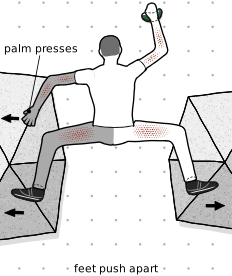
Figure 29 Back view between two volumes. Each foot pushes into its own volume. The left palm presses the left one.
Corners
Face into the corner, or turn a little towards the wall with the better holds.
Bend your knees and press outward and down, evenly on both walls [51, 133].
Where there are no handholds, press a flat palm on each wall at chest height [51].
Step up a short way at a time. Big steps collapse the position (judgement).
If only one wall has holds, layback the edge of the corner. Walk your feet up the blank wall.
Spread your feet wide to rest. Often you can let go with both hands [134].
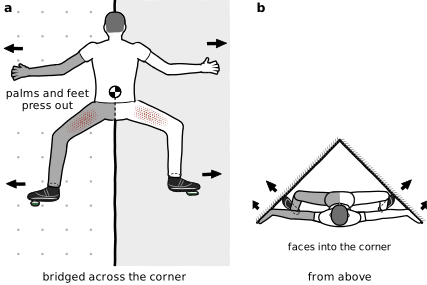
Figure 30 (a) Feet and palms press out into both walls. The centre of gravity sits between the feet. (b) The same position from above.
Common mistakes
Gripping hard with your arms and fingers instead of pressing [132]. Open your hands and push.
Pushing too hard. Relax and let friction do the work [132].
Tall climbers. In a narrow corner your knees get in the way. Turn sideways with one foot still on each wall, or try a backstep: one foot on its outside edge, that hip to the wall [132].