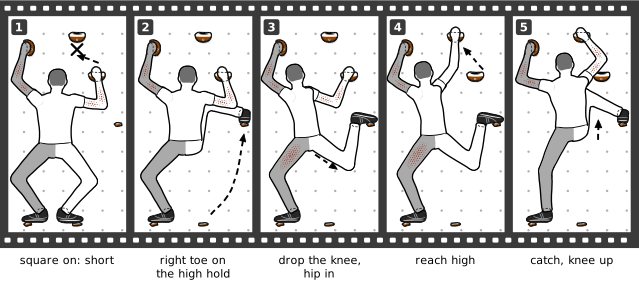
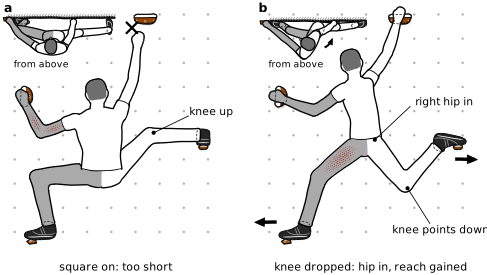
You turn the knee of your reaching-side leg down and inward, so the thigh turns towards the wall. Both feet push apart against two footholds. That pins your hips to the wall and lifts the reaching shoulder [135, 148].
Grade Learn a partial drop knee from V2 on big holds, but leave deep ones until a move needs them (this book’s suggestion). Deep drop knees are rare below elite level [149]. Steep V3s use a partial one. On steep V4s a drop knee is often the intended move. The UK’s coach training lists the drop knee [11], while a US gym teaches it at V5–V6[78].
In motionDrop knee into a long reach
Figure 37 Watch the hips rise and turn as the right knee drops, before the right hand leaves its hold.
How to do it
Find two footholds, one each side [144]. The high one, for the reaching-side foot, sits between waist and shoulder height. The other sits wide and low [148].
Place the foot that won’t pivot first if you can [144].
Put the high foot’s toe on the near corner of its hold. That leaves room to pivot [144].
Turn your hip and that knee in towards the wall, then point the knee down. The foot rolls onto its outside edge. In a deep drop knee, the thigh lies against the wall [148].
For a partial drop knee, stop with the knee part-way down. It gives most of the lock with less load on the knee (judgement).
Straighten the other leg and push out through its inside edge. Your weight moves back over the dropped foot. Your arms unload [122].
Pull in with the holding hand, ideally on a sidepull. Turn your chest towards it. Reach with the hand on the dropped-knee side [127, 144].
Before you stand up out of it, turn the knee back up.
Figure 38 (a) Square on, the right hand falls short. (b) Right knee dropped. The right hip turns in. Both feet push apart. The hand reaches. The insets show the body from above.
Common mistakes
Dropping the wrong knee. Drop the knee on the reaching-hand side, even when your arms cross [144].
Too little room on the foothold. The foot skates off as you pivot [144].
A bent push leg. Your hips drift and your arms take over [119].
Trying it on an overhanging arête or under a roof lip. There is no room [144].
Forcing a deep drop when tired. It loads the inside of the knee: the MCL (the ligament on the inside) and the meniscus (the cartilage pad in the joint) [149, 150]. Chapter 9 gives the injury figures.
Ignoring pain on the inside of the knee. Stop. Rest longer if you are older or have hurt the knee before [149].
Tall climbers. On a wide drop knee, let your knee pass inside your elbow [144]. Long thighs make deep drops awkward in tight spaces, so use a partial one there.