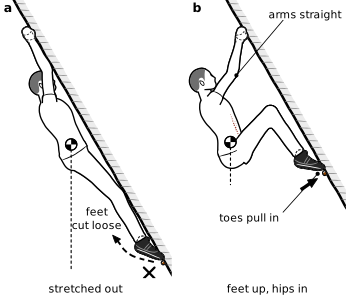
Past vertical, gravity pulls your hips away and your arms take more weight. Overhang technique fights that with high feet that pull, hips turned into the wall and straight arms [35, 47, 107, 113].
Grade Start on the gentle overhangs that become common from V2 (this book’s suggestion). Hörst suggests learning the steep-ground moves on problems about 20° past vertical [47]. Gresham lists bent arms with square hips on steep ground as a beginner-to-intermediate fault [35].
How to do it
Bring your feet up as the wall steepens. Your legs then keep a share of the weight [107].
Press each toe down and into its hold, as if gripping with it. Don’t slap the ball of the foot onto it [35, 107]. See Pulling with the toes.
To reach, turn the hip on the reaching side into the wall. Stand on the outside edge of that foot, on a hold below or behind you. Brace the other foot so you stand on a tripod [35, 47]. See Backstep and Twist lock.
For a longer reach without jumping, use a drop knee[113].
Start each move with your hips, then pull. Don’t lead with your head [107].
Where the footholds face sideways or down, hook them. See Heel hook and Toe hook.
Figure 90 (a) Low feet and high hands. The body hangs in a straight line and the feet come off. (b) Feet up, toes pulling in, arms straight, hips close.