Also called inside edging, outside edging · Feet and legs
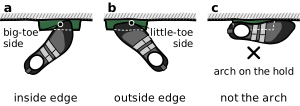
You stand on a foothold with the edge of the shoe near the toe: the inside edge is the big-toe side and the outside edge is the little-toe side. The edge you choose decides which way your hips face.
Grade The inside edge is the first footwork most climbers learn [93]. The outside edge comes in around V1, when your hip starts to turn in. It decides moves on steep V2–V3s, where square-on hips stop working (judgement).
How to do it
Inside edge
Turn your knee and foot outward so the big-toe side faces the hold [96].
Put the front of the inside edge on the best part of the hold. That is the part under the big-toe joint [86, 98].
Angle the foot about 45° to the wall. Then your ankle can’t touch the wall [86].
Keep the ankle at about a right angle. Curl the toes over the hold [81].
On an edge that slopes down, lift the heel. On an edge that slopes up, drop it [86].
Put the front of the outside edge on the hold, just ahead of the little toe. Don’t use the side of the foot [86].
Point the toe down a little and lift the ankle. Your knee drops and your hip rises [96].
Brace the other foot against the wall. Your hands and feet now form a stable tripod [35].
Figure 12 Right foot seen from above. (a) Inside edge: the big-toe side on the hold. (b) Outside edge: the little-toe side on the hold. (c) Don’t stand on the middle of the foot with the ankle against the wall.
Common mistakes
Standing on the middle of the shoe, near the arch. Move the foot until the front of the edge is on the hold [86].
Heel at the wrong height. Too high and the foot pops. Too low and the toe loses grip [95].
Tall climbers. On sit starts, sit side-on with the outside edge on the foothold [35]. That avoids the deep frog squat that long thighs find awkward.
Small climbers. When a hold is just out of reach, stand on the highest usable part of the foothold [63] and drive up through your big toe with your calf [62]. One climber reckons that rising on your toes gains a few centimetres [60], but a heel that goes too high can pop the foot [95].