Rockover
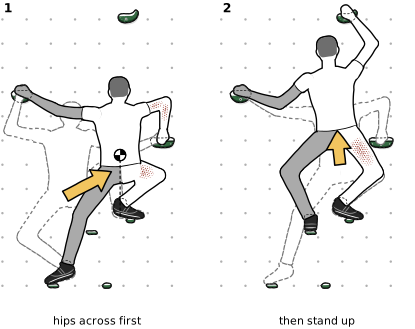
V1+You move your weight onto a high foot and stand up on it. The leg lifts you, not the arms.
Grade It finishes a high step, so you meet it at V1 on big, high footholds (judgement). Hard ones come later, on small footholds with poor handholds: a gym clinic lists rockovers and mantles among skills common on V5–V6 [78].
How to do it
- Set the high foot precisely. See High step.
- Move your weight across towards that foot first, not up. Once you are over the foot, standing up is easy [102].
- Bring your hips and chest over the foot [51].
- Straighten that leg to stand [51, 101].
- Don’t kneel on the hold. Kneeling makes standing up harder [101].
- Over a heel: learn the heel hook first and read its warnings (this book’s suggestion). Then pull with the heel and push with the lower leg. Press down with one or both hands at the same time [91].

- Related
- High step, Hand–foot match, Mantle, Heel hook
- Sources
- [51, 78, 91, 101–103]
- Referenced from
- High step, Hand–foot match, Heel hook, Frog position, Mantle, Slab technique, Top-outs, Progression map, V1 (Font 5), From V4 to V5, Climbing tall, Slab and volumes, Problem 1: Slab, Problem 3: Overhang