Problem 6 Long gap
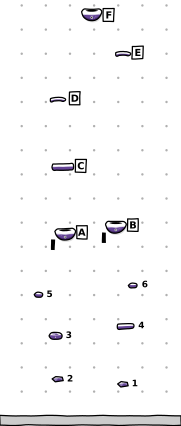
About V5. The wall overhangs 25°, seen from behind. Start: left hand on A, right hand on B. Finish: both hands on F.
Read it yourself
- Step 3. Which holds could stop a moving body? How many hands fit on E?
- Step 4. Give C, D, E and F an L, an R or both.
- Step 5. Which footholds are biggest? Count the holes to E from each one. Which let you reach it?
- Step 6. Static, deadpoint (a catch at the top of your rise, feet on) or dyno (a jump, feet off)? What would change your answer?
- Step 7. What is the setter testing?
The answer to problem 6
The moves
- Right foot on 1, left on 2. Left foot to 3, right foot to 4.
- Left hand to the left end of C.
- Right foot to 6 under E, on the inside edge of your shoe. Left foot to 5.
- Right hand up to C, beside your left. From B it can’t hold you in while your left hand moves (judgement).
- Lock off on C with your right arm and take your left hand up to D. Your left arm can hang straight there. At the catch of E, D is above your shoulder. C would be below.
- Let your hips sag out on that straight arm [217]. Drive through your right leg in one movement, hips in and up [21]. Send your right hand from C to 2–3 cm above E [216]. Close it in a half crimp at the top: a full crimp at speed risks your fingers [161]. Then push down through your right foot [207].
- Left foot up to A. Right foot up to B and stand.
- Left hand to F, then right hand to F.
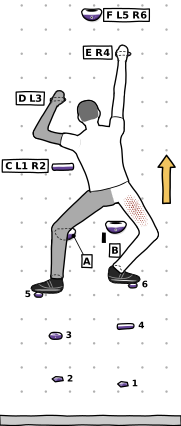
Crux. Move 6. The question is whether you choose a deadpoint. E takes one hand and has a foothold under it, so you want a foot on as you catch it. A slow lock-off may just reach E. But it keeps you on one bent arm on D for the whole reach [21]. Stepping a foot up to A or B shortens the rise, but it folds you up with your hips out (judgement). With both feet on A and B you can skip E for F. But D is then no higher than your shoulder as you throw, so nothing holds you in (judgement). A dyno would suit a jug at E with no foot 6.
Why the obvious try fails. It looks like a dyno: no hold above B on that side until E, and two big footholds low down. So with your left hand on C you stand on 3 and 4, sink and jump. That is about twice the rise. Even if you stick E, your feet are off. Small edges must then stop the swing, which may pull you off (judgement).
What to try next. If you fall short, drive your hips in and up [217, 220]. Or use your outside edge on 6 for a hip pop [217, 219]. If your fingers touch and slide, send your hand sooner.

