Problem 4 Steep wall
About V4. The wall overhangs 35°, seen from the side. The lettered holds run in one line, about 50 cm apart along it. A has room for two hands and C for one. Foothold 3 is wide enough for two feet. Start: both hands on A. Finish: both hands on E.
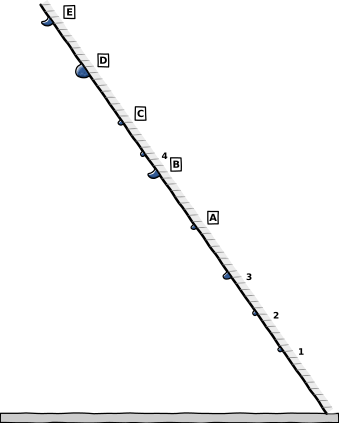
Read it yourself
- Step 2. You can’t tell left from right from here. What can you see that you couldn’t see from behind?
- Step 3. Compare the profiles of B, D and E. Which one has no lip to hook? Where does that want your hips?
- Step 5. Which holds could take a foot?
- Step 6. Which hand moves need your full stretch? What do you stand on for them? What is each leg doing?
The answer to problem 4
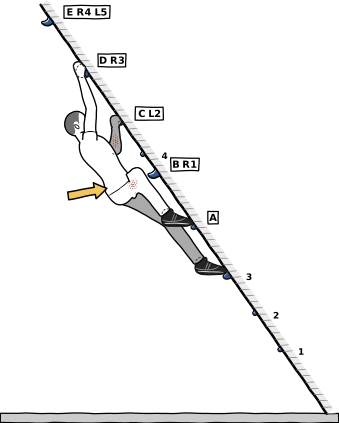
The moves
- Left foot on 1, right foot on 2. Right hand to B. Hang on your straight right arm.
- Right foot to 3, then left foot to 2.
- Left hand to C.
- Left foot to 3, beside your right. Right foot up to A, on its outside edge. Drive the toe in and pull. Keep your whole body tight and your hips in.
- Lock off on C. Turn your right hip in and take D with your right hand. Use a small deadpoint (a catch at the top of your rise) if you need one. Square your hips once you hold it.
- Left foot up to A beside your right. Right foot to B.
- Deadpoint to E: rise with your right hand on D and let go as the rise slows. Then left hand to E.
Crux. Moves 5 to 7. C is a flat edge, which loses grip as you turn [121]. Your toe is on a thin edge while your hand goes to the worst hold. Then both feet come up: D rolls and C drops to your waist. So go for E in one movement.
Why the obvious try fails. You stay on the big foothold and reach for D. From feet 2 and 3, D is about 30 cm out of reach. From both feet on 3 you reach it only with both legs straight. Your feet tend to come off [107] and you land on a sloper with no tension (judgement). With your left foot on 3, a higher right foot adds no reach. It keeps one leg bent to pull and drive with.
What to try next. If the toe pops, place it again and press it down and in [86, 107]. If your hand rolls off D, your hips swung out: pull them in. Both toes on A give about 45 cm more reach, but you catch D with your hips out and it rolls sooner [43, 163, 184]. From both toes on A you could skip D, but nothing is above you as you rise to E (judgement).


- Entries
- Pulling with the toes, Body tension, Sloper, Deadpoint