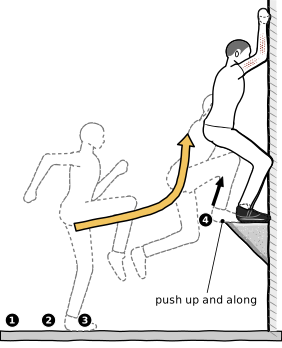
You run a few steps across the mats and jump to catch a hold you couldn’t reach from standing, often with one foot pushing off the wall or a volume on the way.
Grade Learn it from V3 on big holds (this book’s suggestion). It is a competition move that gyms now set for ordinary climbers, often at lower grades [202], so expect it on competition-style problems from about V4 (judgement).
How to do it
Walk it first. Mark the take-off spot and the take-off foothold. Count your steps back, usually two or three. Decide which foot hits the wall.
Wear softer shoes. They make short sprints and jumps easier [44].
Push the wall foot up and along the line you want to travel. Don’t kick into the wall [236].
Keep your eyes on the target. Then reach for it.
As you catch, tense your stomach. It keeps you on when your feet cut after a big sideways move [235]. Get a foot on as soon as you can.
Figure 76 Take three steps across the mat. Push off the volume. Catch the hold.
Common mistakes
Running into other climbers. Check the runway before every go. These problems get in the way when the gym is busy [237].
Skipping the warm-up for hips, knees and ankles [44].
Tall climbers. You may reach the start with a standing jump. If the rules allow, do that. A run adds speed you then have to land with. If you do run, treat the whole runway as your landing zone.